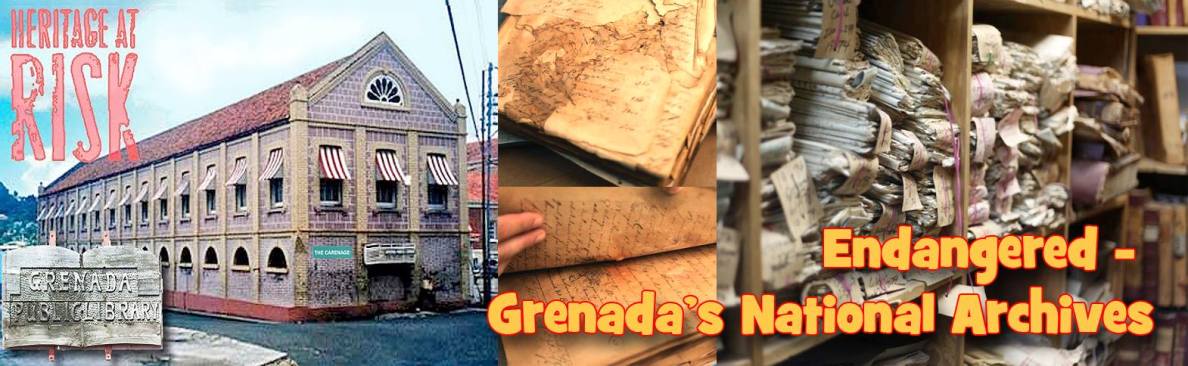
Update: Transcription from Grenada’s Archives Published
Dr Laurence Brown (University of Manchester) has published a 73 page transcription of images from “Court of Oyer and Terminer for Trial of Attained Traitors record book 1796”
[part of Grenada’s endangered archives digitised series EAP295/2/6/1].
It includes notes, the transcription and an alphabetical list of names
from 1796.
Rising seas swamp a cemetery on Carriacou, Grenada.
The Good News
One of Grenada’s most important commodity is Tourism. All our other
resources are equally important and of cause should be regarded
hand-in-hand with our Tourism Resources. On the 9-11 of July 2014 the Center for Responsible Travel (CREST) held the 3rd Symposium for Innovators in Coastal Tourism
here at St. George’, Grenada. This event brought together over 150
‘green’ experts and practitioners, including hoteliers, real estate
developers, operators, investors, and others within the tourism industry
committed to (or considering) new sustainable models of marine,
coastal, and island tourism development and management. Over 40 of
these international tourism experts spoke on various aspects of
sustainable coastal and marine tourism and the event was even
represented for us by our Minister of Tourism and Alexandra Otway-Noel,
who bolstered Grenada’s enthusiasm for a sustainable future through
tourism, and stating action is already underway. View the Symposium Proceedings.
The Down Side
Sadly none of this covered our Historical or Heritage acpects of the
island of Grenada – a very important commodity for tourism, our island
community and the education of our young.
Russ Jarman Price was telling the audience at this international
symposium that these and many other words had been offered to describe
our island nation of Grenada. Collecting such descriptors was one step
in the process that his team used in coming up with its new “Pure Grenada” marketing campaign.The
new brand had provoked local controversy, even though the “pure” theme
is intended to help spur Grenada into becoming a model of sustainability
for the region – you will see it used all over Grenada’s new tourism
site.
The conference represented the Grenada’s next step in staking out
that claim: A three-day symposium on Innovations in Coastal Tourism,
held this month at St. George’s University in Grenada. CREST, the
U.S.-based Center for Responsible Travel, organized it. Symposium
discussions moved along two closely related tracks: How to practice
coastal tourism more responsibly in a world of rising seas, declining
ocean quality, and growing tourism pressures, and more specifically, how
to do so in Grenada and the Caribbean. (Shockingly Jonathan Tourtellot
also spoke at the symposium, but the compete Caribbean development fund
covered his travel expenses.)
Jarman Price was sensitive to the audience, the majority of cause
Grenadian – the Ogilvy’s campaign “Pure Grenada: Freedom to Wonder” had
been systematically thought out. For those who don’t know he is the
Executive Creative Director for Inglefield/Ogilvy & Mather Ltd (the
Caribbean part of global advertising giant Ogilvy) and a local resident.
Many have encouraged Grenada for several years to adopt a geotourism approach focused on its numerous unique qualities (though they constantly forget Heritgage) and the Pure Grenada was characterized as a geotourism rebranding campaign when Ogilvy introduced it in February of this year. National Geographic Society have defined geotourism as “tourism
that sustains or enhances the geographical character of a place—its
environment, culture, aesthetics, heritage, and the well-being of its
residents.” A great fit for Grenada.
Unfortunately, things had not gone smoothly back in February.
Symposium speakers Andy Dumaine and Todd Comen check out a bin of nutmeg husks, from which mace is made, at the Belmont Estate.
Jarman Price admitted, the new brand rolled out “in isolation,” with
the usual inadequate community preparation. Partly because of
that—rebrandings often get public push-back anyway—a storm of
controversy arose. Many Grenadians objected, mistakenly assuming the new
slogan was intended to replace Grenada’s long-standing identity as the “Spice Island,”
a nod to its many nutmeg trees. After much politically hyped debate, PM
Keith Mitchell himself had to intervene, yielding the camel-like
compromise “Grenada, the Spice of the Caribbean” – oh how we continue to show our ignorance!
Make of that what you will. The intent of Pure Grenada was to underscore what is considered the real reason to visit: The island is one of the last to offer a broad and authentic Caribbean travel experience.
Grenada still has beauty, a benign climate, rich culture and heritage,
good beaches, still-viable nature on land and in the sea, and relative
freedom from intrusive mass tourism.
Can Grenada Pull It Off?
The question is whether our country can retain and build on that
distinction. Like other islands, Grenada copes with numerous
challenges—overfishing, sand mining, unemployment, irresponsible
development, care-less attitute to heritage, limiting-unencompassing
education. Take for example the terrible loss of our wave-swamped cemeteryon
our sister island of Carriacou – it has become an emblem for the
Caribbean’s accelerated sea level rise. Certainly since the financial
crisis, but truely even before the 1970′s, our government has basically
been financially broke, and many of us Grenadians are therefore eager to
grab at any economic opportunity, sustainable or not – with no care for
the longer term stategies to protect our island and including our
heritage for our youth (those who will become custodians in long after
we’re gone).
Sockingly at the Symposium we were reminded that someone on Carriacou had chopped down about seven acres of mangroves to make room for a big new marina! That environmental insult, which most certainly contributed to the demise of one of ancient cemeteries, was mentioned repeatedly at this symposium—a pimple of the face of Pure. In ignorance apologists often argue for a “balance between growth and conservation” in such cases. Sustainable marketing consultant Andy Dumaine grumbled when he heard that: “It’s not an either-or”. Other endangered cemeteries are Mt. Airy cemetery in St. Paul’s and the church
yard cemetery of St. Paul’s Anglican Church (the graves are literally
sliding down an embankment into a ravine).
Indeed, Dr. Angus Friday, our current ambassador to the United States and Mexico, encouragingly believes sustainability is
economic opportunity. He sees Grenada as taking a global lead in
renewable energy and conservation for small island nations. While
diplomatically not mentioning those missing mangroves, he argued, “Our
natural capital is principal in the bank. We need to weave this into our
DNA”. This implies that Good businesses don’t invade principal.
Is Friday in the minority when he hopes that Grenada can develop in a
way that disrupts the standard model of Caribbean tourism—“Become the Airbnb of responsible travel”.
Let us hope it can be done and the symposium itself seemed quite successful. (Presentations here.)
At a geotourism meeting the next day, it became clear that
many of our boutique hotel owners that dominate the Grenada tourism
market don’t want to see huge all-inclusive resorts or more big cruise
ships. But tourism growth is so much more than these two areas. At a rural exposition
on another day, many of our local artisans and ‘entrepreneurs’ took the
opportunity to show off wares unique to our island, keen to grow their
businesses through ‘responsible tourism‘. They had set up their booths at Belmont Estate, which itself has become one of our well-known agritourism attractions in the Caribbean.
Local entrepreneur Modesty makes Grenadian-themed fashions and hopes to add employees.
And what about those spices? Grenada’s big three are nutmeg, mace,
and cinnamon. One visitor remembers landing at the Grenada airport long
ago, entering the terminal, and immediately smelling these telltale
scents. However the Symposium visitor detected no such pleasant odor
when they arrived this time. What an opportunity missed, and an other
aspect of our heritage dies! Research tells us that the brain’s wiring
for memories and for smells are directly linked one another. Why not
once again suffuse the airport arrival and departure halls with
delicious fragrance? Do that, and every time for years after, when we
former visitors smell cinnamon on a roll or nutmeg in the eggnog, we’ll
remember:
Ah, Grenada.
A biography is a history of a person’s life. A biography may give you
birth, marriage, and death information and the names of parents,
spouse, children, or other family members. Use the information from a
biography cautiously because there may be inaccuracies.
Biographies have been gathered and published in collections of
biographies, sometimes called biographical encyclopedias or
dictionaries. These usually include only biographies of prominent or
well-known subjects. However, some collections of biographies are of
specific groups such as ministers, musicians, painters, poets, radicals,
or writers.
It is important to note that currently there is little in the way of
individual or collective biographies on individuals born in Grenada or
for those who have had great influence or participation in Grenada
politically, socially, or otherwise. One would hope this will change in
the future.
If your ancestor played an important part in a group or occupation, do a Place Search for Grenada in any British, Scottish, Canadian,
North American, and Latin American biography archives, since people of
note may be recorded in these. Although Grenada has little to do with
Latin America many historical groups have collected Caribbean
information which can include biographical details from Grenadian
figures. Little work has been done on collections of biographies of
African, Indian, or Portuguese descendant who have lived and died on
Grenada’s islands.
Sources
For prominent historical figures, leaders, artists, businessmen, or religious the following sources may help:
American National Biography, Oxford: Oxford University Press, 2003. (Print) ANB.org ($).
Oxford Dictionary of National BiographyOxfordDNB.com ($)
This is a small list of prominent figures in Grenada’s long history –
it is neither definitive nor complete. Further, it must be noted that,
as is the case with all biographies, those listed here are neither the
complete truth nor the whole life of the given individual.
Name (A)
Biographical link
Arthur, James Stanley (1923–2010)
Oxford University Press, 2014
Augustine, Fennis Lincoln
Oxford University Press, 2014
Name (B)
Biographical link
Beharry, Johnson (1979–)
Damian Lynch, Garrick Hagon, and Nick Cook. Barefoot Soldier. Sphere, 2006
Benjamin, John (1934–2010)
The Cultural Biographies of John Benjamin & Fernande Laas. S.l: s.n, 1990
Bishop, Maurice Rupert (1944–1983)
Howard, Johnson. Oxford: Oxford University Press, 2009
Blaize, Rt. Hon. Herbert Augustus (1918-1989)
Oxford University Press, 2014
Brizan, George Ignatius (1942–2012)
Brave Young Grenadians: Loyal British Subjects…. Trinidad & Tobago: G. Brizan, 2002
Triangular Road: A Memoir. New York: Basic Civitas Books, 2009
Mcintyre, Sir Meredith Alister (1932-)
Oxford University Press, 2013
Name (P)
Biographical link
Palmer, Sir Reginald Oswald (1923-)
Oxford University Press, 2013
Paterson, Nicholas Julian (1867-)
Oxford University Press, 2014
Phillips, Harold Adolphus (1929–2000)
James, McGrath. Phillips, Harold Adolphus. Oxford: Oxford University Press, 2012
Pigott, Sir Arthur Leary (1749-1819)
R, A M. Pigott, Sir Arthur Leary. Oxford: Oxford University Press, 2004
Pitt, David Thomas (1913-1994)
Mike, Phillips. Pitt, David Thomas, Baron Pitt of Hampstead. Oxford: Oxford University Press, 2004
Protain, Gertrude Isobel (-2005)
Compton, Shadel N. Gertrude Isobel Protain: Glimpses into the Life of a Great Grenadian. St. Patrick, Grenada: Belmont Estate Heritage Foundation, 2004
Purcell née Orgias, Joan M. (1942-)
Memoirs of a Woman in Politics: Spiritual Struggles of Joan M. Purcell. St. George’s, Grenada, W.I: J.M. Purcell, 2007
Name (R)
Biographical link
Robertson, James Burton (1800-1877)
Thompson, Cooper, and Lloyd Myfanwy. Robertson, James Burton. Oxford: Oxford University Press, 2004
Roux, Phillippe de
Le Marquis de Casaux, un Planteur des Antilles, Inspirator de Mirabeau. Paris: Société de l’histoire des Colonies Françaises; en vente: Libraire Larose, 1951
Name (S)
Biographical link
Scoon, Sir Paul Godwin (1935–2013)
Survival for Service: My Experiences As Governor General of Grenada. Oxford, England: Macmillan Caribbean, 2003
Shrewsbury, Rev. William James (1795–1866)
Memorials of the Rev. William J. Shrewsbury. London: Hamilton, Adams, 1867
Name (W
Biographical link
Watts, Sir John Augustus Fitzroy
Oxford University Press, 2013
Wharton, Arthur (1865-1930)
Phil, Vasili. Wharton, Arthur. Oxford: Oxford University Press, 2004
Williams, Eric Eustace (1911-1981)
Palmer, Colin A. Eric Williams & the Making of the Modern Caribbean. Chapel Hill: University of North Carolina Press, 2006
Williams, Sir Daniel Charles (1935-)
Oxford University Press, 2013
You may find some collections under the localities listed above and then the subject “GENEALOGY.”