Showing posts with label Preservation. Show all posts

16 Apr 2015

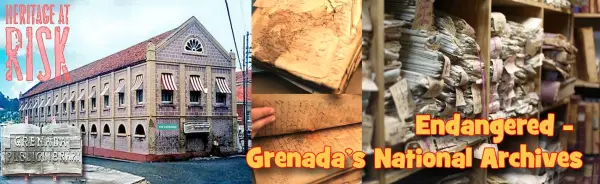
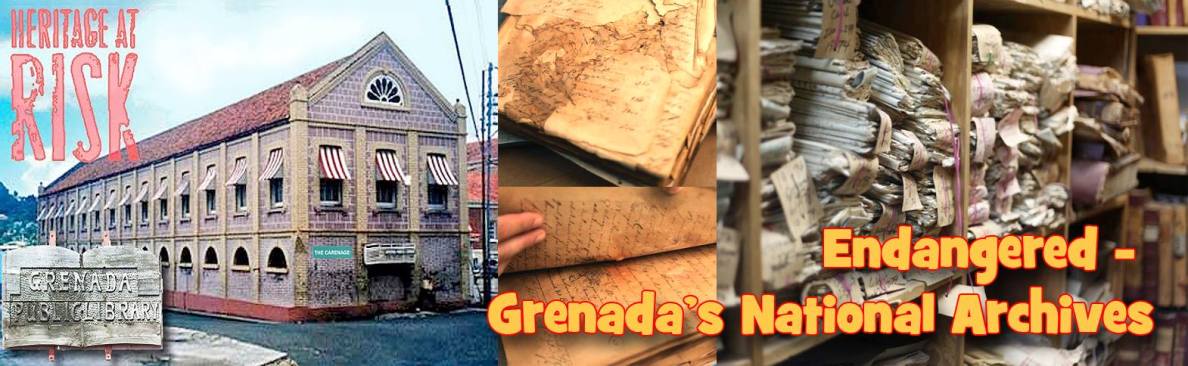
Grenada's Endangered Archives

Caribbean archives under threat: Grenada

Unbeknownst to almost any Grenadian a submission was put to Unesco for funding towards the further “Digitizing and Preservation of Grenada’s National Archives” and in July of 2014 Unesco approved a tiny sum of US$22,000.

Back in June 2012, a year after Grenada’s National Archive official closure (though it hadn’t functioned since 2004), a group in Reading (UK) known as the “Diasporic Literary Archives Network” (diasporicarchives.com), headed by Alison Donnell (Professor at the University of Reading), held a two-day opening Workshop on the “Questions of Location, Ownership and Interpretation“. At this workshop a presentation was given by Merle Collins and Alison Donnell which bought a good deal of attention to the situation of archives caught up in problems of a material and political nature, such as Grenada’s not having at the moment an accessible building for its archive.

The group continued discussions about how best to work with and support local initiatives to improve library and archival facilities in Grenada. On behalf of the Network, David Sutton sent an expression of support that was warmly received by Minister Franka Alexis-Bernardine.

At the same time Merle Collins announced the establishment of a not-for-profit organization called Grenada Libraries, Archives and other Heritage Support Group (GrenLib), that could raise awareness and funds in the diaspora. Articles have been drawn up with signatories in Grenada, New York and Washington. An inaugural fundraising event, Grenada Cultural Extravaganza, was held in New York in November 2013.

A “Grenada Library and Archives Committee”, organized from within Grenada, was purportedly established with both Merle Collins and Alison Donnell as members with one meeting to date. Ms Collins talked to her international Grenada diaspora organization which has members from Canada, the U.K. and various parts of the U.S.A, and Grenada’s Diaspora Office.

Follow-up work took place at the Caribbean Studies Association 38th Annual Conference in Grenada in June 2013, were Lillian Sylvester (Director of Libraries, Grenada Library Services), Collins and Donnell presented a panel on “Valuing the past: libraries, archives and the ‘development’ of literary culture in the Anglophone Caribbean” which focused special attention on Grenada.

Two years later, in 2014, Glenlib held their first annual “Diaspora Give-Back Fundraising Event” at the University of Maryland with the Friends of Grenada Library, Archives and other Heritage Committees.

In September that year another Workshop was held in which Cheryl Sylvester (Faculty Librarian at St George’s University) highlighted the situation in Grenada:
…it is not just a shortage of professional expertise that prevents full exploitation of archival material, but the fundamental absence of a building suitable for housing a national library and archives since the damage caused by the hurricane of 2004. A transnational campaign to replace the former Public Library, supported by the Friends of Grenada Library, Archives and other Heritage Committee (GRENLIB), is attempting to fundraise for a new building, but for Sylvester, a higher level of government commitment is required if the building is ever to become a reality.
Whilst there remains no national archive building in Grenada important holdings remain at risk of being lost, stored in inadequate conditions and liable to environmental degradation.

Further, at the Society of American Archivists’ August 2014 Issues & Advocacy Roundtable (IART), Ms Sylvester discussed the “Threat to national archives and library in Grenada” and reported:
  • Since 2011, the library/archives building has been closed, with the collection stuck inside, and the collection (including records of the 1983 American invasion) is at risk
  • Library building was already in a state of disrepair when Hurricane Ivan did further damage in 2004; archives on top floor was damaged (shelves are being eaten away by termites)
  • In the meantime, political supporters of the library lost power
  • The previous Minister of Education sought several alternative locations, didn’t work out because of internal wranglings
  • There’s been a change in government, but the situation remains the same
  • Director of Libraries role is uncertain – unclear whether the government still considers the role to be active
  • A request to the SAA that they consider joining other international information
    professional organizations (ICA, Association of Caribbean Academic Libraries, etc.) in writing to the Minister of Education, who has responsibility for libraries and archives
  • Other advocacy efforts related to this issue:
    • last year, a paper was presented at the CARBICA conference about archives that need attention
    • In March 2014 a paper was written on the state of archives in Grenada
  • Next steps: Sarah Quigley said I&A would be glad to draft a letter and send it to our SAA Council Rep (and the appropriate SAA committees), remembering the SAA had already donated through CARBICA US$1,000 back in March 2005 to the Grenada Archives Mission.
In its 2015 mandate on “Caribbean archives in the Caribbean: a new future” Alison Donnell (DLAN), said the group is committed to finding ways of sustaining and supporting this work into the future. The Network expects also to continue its solidarity work with archivists in Grenada in 2015 and beyond.

In January 2015 at the “Politics of Location” workshop held at Yale, Helena Leonce (Trinidad Archivist) gave an update in which she stated “The Caribbean region has embarked on a number of digital initiatives, in an attempt to keep abreast with the technological advances that are taking place in the world. Plans to digitize literary archival material have also been given great consideration.”
The DLAN’s principal investigator (and Director of Research Projects in the University of Reading Library since 1982), David Sutton, reiterated what Cheryl Sylvester had told him about the situation of Grenada’s National Archives:

A digitization project has been started which is on-going. This project was initiated by the UNESCO Secretariat through IFAP. The aim is to digitize old records at the library.
Progress Report
  • Government gazettes from 1880’s to 1920 are completed;
  • West indian chronicle 1880’s to 1890’s with gaps;
  • Blue books 1900’s & colonial letter registers from 1800’s begun.
Also an attempt was made with the Alister Hughes newsletters and the revolutionary documents at the fort were nominated for Unesco ‘Memory of the World’ registers but this clearly failed because the newsletter had already been digitized on DLOC (Library of Congress website) and so is therefore no longer under threat.

The Revolutionary documents have to be cleaned and inventoried so that proper documentation can be carried out to enable their digitization.

However Cheryl Sylvester completely overlooked the US$60,000 work that Dr Laurence Brown team from University of Manchester had initiated in 2010 with the help of “Endangered Archives Project” of The British Library and completed in February 2014 which had 2500 pages of twelve volumes digitized material at the Supreme Court Registry (from 132 identified).

[See Grenada's Endangered Archives (part 6)]


Remember to check out the latest by joining our Facebook Group at Grenada’s Endangered Archives
« Prev Page | Next Page »

2 Aug 2014

HELP TO GET GRENADA BMD INDEXED AND ONLINE

When will Grenada be able to Discover their family history.
 
Since 1974, the Church of Jesus Christ of Latter-day Saints (LDS) has been extracting records of births/baptisms and marriages from filmed records in its collection for countries around the world. Most of these extracted records are indexed by name in the International Genealogical Index (IGI) available on www.familysearch.org.

However, IGI / FamilySearch has *NOT* indexed much of Grenada’s vital records.

Fortunately as of October 2017 serveral of the Grenada Church Family Registers have been digitized and are (with heavy restrictions) now available to view online. Recently the LDS have offered more locations from which to view these records through their Family History Centres and their Affiliates, however in the Caribbean, there none on Grenada and only one (often broken) computer each on Barbados, St Vincent. You may also get access from the one on each island of Trinidad, Martinique, Guadaloupe, Antigua, and St Kitts, and the five that are reportedly on Puerto Rico. Of cause from the UK, Europe, North America, Canada and Australia you will have hundreds of access points.

The Family History Library Film numbers on file for the seven parishes (St George, St John, St Mark, St Patrick, St Andrew, St David and Carriacou) of Grenada are:

1.1 No. 1523145 – Births for 1866 to 1874
1.2 No. 1523169 – Births for 1874 to 1888
1.3 No. 1523187 – Births for 1888 to 1892
1.4 No. 1523204 – Births for 1893 to 1905
1.5 No. 1523217 – Births for 1905 to 1910
1.6 No. 1523259 – Births for 1911 to 1916
1.7 No. 1523339 – Marriages for 1903 to 1910
1.8 No. 1523352 – Marriages for 1910 to 1918
1.9 No. 1523353 – Marriages for 1919 to 1922
1.10 No. 1523361 – Marriages for 1922 to 1932
1.11 No. 1523537 – Deaths for 1866 to 1890
1.12 No. 1523656 – Baptisms 1784 to 1932, confirmations 1901 to 1931, marriages of Anglican, slaves, St Pauls, St Luke, St Peter, special, burials, burials of slaves and St Pauls, [not indexed nor digitized]
1.13 Land Registers - Not indexed nor digitized†.

The problem is that Grenada’s civil birth records do not name the child it is only the Church Baptism registers which do this. Sadly, too, the only THREE Family History Library (FHL) films that HAVE been indexed are from birth registers:-

Film number 1523145 – This is a copy of parts of the Civil Register of Births from all seven parishes for 1866 to 1875 in twelve items corresponding to batch numbers I02551-1 to 1 to 12.
Film 1523169 – Births from all seven parishes for 1875 to 1882 (eleven batch numbers I02552-1 to 11).
Film 1523187 – Births from all seven parishes for the years 1882 to 1891 (eleven batches I02553-1 to 11).

THE SERIOUS PROBLEM WE HAVE IS THAT THESE FILMS, THOUGH NOW DIGITIZED, HAVE NOT YET BEEN INDEXED:-

Film 1523204 – Births from all seven parishes for 1891 to 1905.
Film 1523217 – Births from all seven parishes for 1905 to 1910.
Film 1523259 – Births from all seven parishes for 1910 to 1916.
Film 1523537 – Birth registers – five items 1 through 7 for 1900 to 1935 more specifically –
August 1910 to December 1910 in Carriacou
January 1911 through to June 1915 in All seven parishes
January 1916 through to December 1916 in All seven parishes

Film 1523362 – Index to 3 marriage volumes for 1903 to 1932.
Film 1523339 – Marriages from all seven parishes for 1903 to 1910.
Film 1523352 – Marriages from all seven parishes for 1910 to 1918.
Film 1523353 – Marriages for 1919 to 1922 and 1924 to 1928.
Film 1523361 – Marriages from all seven parishes for 1928 to 1934.
Film 1523537 – Death from all seven parishes for 1928 to 1934.
Film 1523394 – Births from all seven parishes for 1905 to 1924 has not been digitized nor indexed.
Film 1523396 – Births from all seven parishes for 1905 to 1935 has not been digitized nor indexed.
Film 1523429 – Births and Deaths from St John and St Andrew parishes for 1900 to 1932 has not been digitized nor indexed.
Film 1523408 – Deaths all seven parishes for 1909 to 1936 has not been digitized nor indexed.

THE FOUR MOST IMPORTANT FILMS NOT INDEXED NOR DIGITIZED

These four films are the ONLY source of the christian name of a child in Grenada.

Film 1523692 – This most important film and ONLY record of a childs birth-name is of Baptisms, Births, Marriages, Burials all seven parishes for 1798 to 1931 has not been digitized nor indexed.
Film 1523752 – This most important film and ONLY record of a childs birth-name is of Baptisms, Marriages, Marriage Banns, and Burials all seven parishes for 1861 to 1931 has not been digitized nor indexed.
Film 1523767 – This most important film and ONLY record of a childs birth-name is of Baptisms, Marriages, Burials St Mark, St John and Carriacou parishes for 1900 to 1931 has not been digitized nor indexed.
Film 1523656 – This most important film and ONLY record of a childs birth-name is of Baptisms – it also covers other Confirmation, Bann, Marriage, and Burial registers from the Archdeaconry of Grenada in the Anglican Rectory registers (manuscripts) of the districts of St. Luke, St. Peter and St. Paul in the parish of St. George’s, Grenada for the years 1784 to 1971. So this is film covers:-

Item 2 – Baptisms and burials for 1784 to 1804.
Item 1 – Baptisms, marriages and burials for 1806 to 1831.
Item 3 – Baptisms, marriages and burials for 1812 to 1815.
Item 4 – Baptisms, marriages and burials for 1816 to 1831.
Item 5 – Slave baptisms, marriages 1817-1834, burials 1833-1834.
item 6 – Baptisms and marriages for 1831 to 1837.
Item 7 – Baptisms, marriages and burials for 1837 to 1844.
Item 8 – Baptisms for 1844 to 1892.
Item 9 – Baptisms of the district of St. Luke for 1851 to 1884.
Items 10-11 – Baptisms for 1892 to 1932.
Item 12 – Confirmations for 1901 to 1931.
Items 13-14 – Marriages for 1844 to1930.
Item 15 – Marriages for St. Luke and St. Peter 1909 to 1933.
Item 16 – Banns for 1903 to 1931.
Item 17 – Special marriage register 1912 to 1942.
Items 18-19 – Burials 1844 to 1930.
Item 20 – St Paul Marr. 1861-1902, Bapt. 1860-95, Bur. 1861-1971.

A TINY HOPE FOR HELP

FamilySearch do run ‘projects’ to continue the indexing of FHL films on file. However they insist:-
Information about upcoming collections is not made available prior to publication due to various factors that can affect the publication time line, such as contract agreements with record custodians or partnership societies, final assembly considerations, server capacity, geographic considerations, prioritization of collections at risk, delivery type, and so forth”.
Further “…there is no specific time frame for the publication of indexing projects, since they are governed by the same considerations as indicated above“.
This terrible situation may only be overcome by having everyone making a request that the entire GRENADA COLLECTION be added to their online collections, to do this please follow these instructions:-
1. Go to the FamilySearch website (http://familysearch.org).
2. Scroll down to the bottom of the page, and click on the Feedback button.
3. Click on Share your ideas, and post to request ALL OUR FILMS BE INDEXED AND PUT ONLINE.
Or use a direct link to FamilySearch “Send Us Feedback” website. Then click on Share your ideas and post your request.

Note: Posting does not guarantee that familysearch.org will be able to acquire the collection or have rights to publish it, but the requests will be seen by those who make decisions about which collections are published.
 
A further note: Much earlier French records from the era 1765-1790 of Grenada’s history have now been digitized and can be freely viewed online via the British Library EAP website at link, link, link, link, and link.

25 Jul 2014


Grenada's Endangered Archives

Grenada’s endangered archives programme (EAP295)

Update: Transcription from Grenada’s Archives Published

Dr Laurence Brown (University of Manchester) has published a 73 page transcription of images from “Court of Oyer and Terminer for Trial of Attained Traitors record book 1796” [part of Grenada’s endangered archives digitised series EAP295/2/6/1]. It includes notes, the transcription and an alphabetical list of names from 1796.


[eap295_2_6_1_transcription.pdf]
Download

Note: A page is missing between 037 and 038 (it was never copied). It containes trial information for 8th August 1796.

Remember to check out the latest by joining our Facebook Group at Grenada’s Endangered Archives
« Prev Page | Next Page »

14 Jan 2014

Grenada's Endangered Archives
The newyear begins and we hear that Pranical Technologies and UNESCO, through the Communication & Information Sector, informs us that the IFAP plans to protect historical documentary resources on Grenada.

Archives damaged by the effects of termites,
Grenada National Library, St. Georges

The Intergovernmental Information for All Programme (IFAP) has recently launched an information preservation project in Grenada, which is helping to protect valuable and rare historical documentary resources. The project is also providing useful experiences that can inform actions in other Small Island Developing States (SIDS). It is one of several initiatives undertaken in the Caribbean during the 2012-2013 biennium with the financial support of UNESCO’s Multi-donor Emergency Fund.

According to Jasmin Garroway, from the National Commission in Anguilla (UNESCO’s newest Associate Member),
the project undertaken in Grenada provides important technical insights that are an inspiration for the members of the National Memory of the World Committee, which is being established“.

Insights into the complex political, social and economic changes that have transformed Grenada over the past 300 years can be found in its national archives. But today, this archival heritage, which managed to survive the military exploits during the colonization of the new World and the more recent Cold-war era, is now threatened by inadequate storage and natural causes.

Hurricane Ivan, which hit the island in 2004, compromised the main library and the national archives. As a result, these collections were dispersed to makeshift emergency storage areas. The limited resources available to the Government, the need to respond to other more urgent human needs, as well as the inadequacy of what was only intended to be temporary storage has seen these precious resources become endangered.

Recently, the Government launched a ‘major effort‘ (sic) aimed at obtaining finances to restore the public library and protect its archives, but even as these plans are being put in place, the ravages of humidity and termites continue their assault on the fragile materials.

Discussions between the IFAP Secretariat and the official Delegation of Grenada during UNESCO’s 37th General Conference helped to identify some immediate interventions that could forestall this degradation. A project was conceived to train government staff and local volunteers in inventorying the archives, relocating them into more favourable locations, protecting them from termites and humidity as well as acquiring equipment to support the digitization of the archives.

N.B. None of the aforementioned consultants of the delegation have been named and ‘training governmental staff and volunteers‘ is a feeble response to the urgency of our plight, and we fear who these ‘information professionals‘ are – still this small response is better than the previous decade of no response.

Joan-Marie Coutain, Secretary-General of the Grenada National Commission, says,
Within the space of a few weeks, our discussions with UNESCO were transformed into a proposal that was then concretely implemented on the ground. We now have young trained Grenadian volunteers working under the guidance of government information professionals and using the equipment acquired for this project to save our documentary treasures.

The intergovernmental Information for All Programme was established in 2001. It provides a platform for international policy discussions, cooperation and the development of guidelines for action in the area of access to information and knowledge. The Programme also supports Member States to develop and implement national information policy and strategy frameworks.

James Gill's photo.


Remember to check out the latest by joining our Facebook Group at Grenada’s Endangered Archives
« Prev Page | Next Page »

12 May 2013


Grenada's Endangered Archives

Digitising the endangered archives of Grenada (EAP295)

As of May 2013 Cathy Collins (EPA Grants Administrator @ Endangered Archives, The British Library, London, UK) wrote:
I am afraid the results from this project are still being finalised so the records have not yet been catalogued or made available online. However, I am optimistic that the last few remaining queries should be sorted out without too much delay now.

Project Outcome – four years on

Before this project, the material from Government House that had survived the 2004 hurricane had been deposited in the basement of the Office of the Governor-General but there was no index, or order to the material. In totally reconstructing this archive the project relied heavily on E. C. Baker’s A Guide to Records in the Windward Islands (1968). All our Government House material was cleaned, repaired, placed in chronological and thematic order and indexed.

Twelve volumes and files of Governor and Lieutenant-Governor’s correspondence were digitised covering the period 1764-1879. The Letter Books of the Administrator and Colonial Secretary were digitised as series P because these were far more fragmented than the Governor’s correspondence. Without an item-level index of material dating from before the 2004 hurricane (Ivan), series P material has been ordered chronologically and digitisation was focused on those works which were seen as the most fragile due to their age or unbound condition.

The material at the Supreme Court Registry was far better preserved than at Government House as it was relatively unaffected by Hurricane Ivan. Loose-leaf documents previously identified as connected to the eighteenth century French Deeds formed the initial focus of in situ digitisation in the Supreme Court Registry. Many of the bound volumes of French Deeds identified by the project required such extensive preservation and conservation work that their digitisation would have destroyed their physical structure. By stabilising their storage and digitising those materials in the Supreme Court Registry which were already fragmentary or fragile, the project was able to make a significant step towards its original aims.

Digitisation

Aside from preservation and restoration – THE most important aspect and concern for this endangered project is with the dititisation and immediate onine access and availablility of our historical records.

Digitisation has continued in the Supreme Court Registry on the Births, Deaths and Marriages Registers for St Georges and records related to Forfeited Estates, 1794-1802. During this time one Archival researcher employed by the project has attempted to clean, sort and order the French Deed bound volumes and unbound materials.

Most significantly copies of all digitised material have been deposited with the British Library. Further copies have been placed with the University of the West Indies, Grenada campus, and this is supposed to be made publically accessible through the new campus that is being constructed on the island. We will just have to hold our breath and wait.

Copies of all digitised material will also be deposited with our Grenada National Archives … when this is too is constructed.

I’m sorry to say that four years has now passed since the project took place and we still await physical access to this virtual data but as seem Grenada’s lot we must wait and see…
Keep up with the Archives News on our page “Grenada’s Endangered Archives” at http://www.facebook.com/groups/158188037685838/
James Gill's photo.
Although back on the 27 September 2013 the Grenada Information Services (GIS) and Education and Human Resource Development of Grenada announce:- 
The Library will be reopened at a new location, in the National Stadium, as the previous building (on the Carenage) is in need of extreme structural repair.  Regular operation is projected to begin early in the New Year. Opening hours and policies are expected to remain the same.
This has little or nothing to do with our National Archive needs.


Remember to check out the latest by joining our Facebook Group at Grenada’s Endangered Archives
« Prev Page | Next Page »

14 Mar 2013

Strengthen Protection of Grenada's National Parks and Protected Areas


The Forestry and National Parks Department (FNPD) in the Ministry of Agriculture has collaborated with the Grenada Dove Conservation Programme (GDCP) on an initiative to further strengthen the protection of two of Grenada’s Key Biodiversity Areas (KBAs) – the Mt. Hartman National Park KBA and the recently cabinet approved Beausejour/Grenville Vale KBA.


These KBAs are home to the critically endangered Grenada Dove, and have received international recognition by Bird Life International as Important Bird Areas.


The Forestry Department and GDCP will be implementing several activities in these KBAs that will enable the conservation of Grenada’s ecosystems and biodiversity particularly the Grenada Dove.


Additionally, this initiative will create livelihood opportunities for neighbouring communities and assist Grenada in meeting its obligations to international conventions.


Some of the planned activities include the implementation of an awareness plan which comprises a song competition and school presentations; the erection of billboards and boundary signs at these sites and the construction of a birding trail at the Beausejour/Grenville Vale KBA.


Presently, community meetings are being held and are continuing to identify livelihood opportunities for residents and the establishment of a stakeholder management team.


Funding for this Project was received from the Critical Ecosystem Partnership Fund (CEPF) and was started in November 2012 and is intended to continue until April 2014.


The Project is titled “Strengthening the Legal Protection of Mt. Hartman National Park KBA and Beausejour/Grenville Vale KBA in Grenada” and is facilitated by Ms. Bonnie Rusk, Founding Director of GDCP since 1991.


Bonnie Rusk, Director of Grenada Dove Conservation Programme and National Park Ranger Peter Plenty on a round checking and rebaiting the tracking tunnels at Mt. Hartman.

Bonnie Rusk is a Conservation Biologist who has dedicated her life to saving the critically-endangered Grenada dove.

“This is my life’s work, this is what I do. It has been all-consuming for the last 18 years,” says the 46-year-old.


Rusk, a Canadian conservation biologist, fascinated by endangered species on islands, began graduate research on the dove in 1991.


Conservation efforts, initiated largely by Rusk (in collaboration with Grenada’s Forestry and National Parks) were succeeding, with the dove’s population rising from around 90 in 1990, to 182 in 2003, when Hurricane Ivan struck in 2004. “The devastation wrought by Ivan was unbelievable, it wiped out at least a third of the dove’s population,” she says.


The dove faced another threat in 2006 when plans to build a holiday resort on one of its last remaining strongholds were unveiled.  Rusk, who lives high in the Colorado Mountains but spends up to five months a year in Grenada, mediated a solution between the interests of the dove and the developers. That resulted in international exposure.

“That made a difference,” she says. “Local people saw this was a big deal and that foreign visitors would come just to see the dove. The dove is unique to Grenada.”


Rusk’s work  includes monitoring population levels; ecological studies on the dove’s dry forest habitat; collaborating with government; community work; awareness campaigns (including television), and school education programmes. She was instrumental in the establishment of two national parks for the dove, and having a dedicated visitor centre built at the Mt Harman Estate. 2007 population estimates suggest 136 doves remain, concentrated in two pockets on the Grenadian south-west and west coasts

“The species cannot decline any further,” says Bonnie, or else extinction looms. “The key is habitat protection. Many other things will come from that but first and foremost we must protect its remaining habitat.”


• Visit www.birdlife.org or contact Bonnie Rusk at bonnie@GrenadaDove.org

3 Jan 2013

Learning by doing in digital preservation

DigitalPreservation


Digital preservation combines policies, strategies and actions to ensure access to reformatted and born digital content regardless of the challenges of media failure and technological change. The goal of digital preservation is the accurate rendering of authenticated content over time. (Source: American Library Association)


The process of maintaining, in a condition suitable for use, materials produced in digital formats, including preservation of the bit stream and the continued ability to render or display the content represented by the bit stream. The task is compounded by the fact that some digital storage media deteriorate quickly ("bit rot"), and the digital object is inextricably entwined with its access environment (software and hardware), which is evolving in a continuous cycle of innovation and obsolescence. Also refers to the practice of digitizing materials originally produced in nondigital formats (print, film, etc.) to prevent permanent loss due to deterioration of the physical medium. Click here to learn about the National Digital Information Infrastructure and Preservation Program, a collaborative initiative of the Library of Congress. The Digital Preservation Coalition (DPC) was established in 2001 to address the challenges of preserving digital resources in the UK. Synonymous with e-preservation and electronic preservation. (Source: Online Dictionary for Library and Information Science)


Libraries, archives and museums have been extremely successful in preserving centuries old paper-based, cultural and scientific heritage. How well are they doing with the growing and rapidly ageing digital-based heritage?


This question has been haunting us (the digital preservation community) for a while now, even though the digital era has only just begun. We are still unsure about so many things: Are we keeping the right information? Should we be more selective? What is the right preservation strategy: safeguarding the original containers and carriers, transferring the data to long-lasting media, emulating the hardware before it becomes obsolete? Which metadata should we record? Et cetera.


At iPRES 2012, keynote speaker Steve Knight set the tone by observing that ”we are still asking the same questions as 10 years ago” and not making much progress. Paul Wheatly pointed to the duplication of effort in research projects and tool-building, and called it “a big fail”.


The conference proceedings do not reflect this discussion - they are a compilation of the papers that were accepted by the Scientific Program Committee – but you will find blogs and tweets that have captured the mood and voices of the participants. The concerns in the community are very real and deserve attention. In a series of blogs, I will attempt to address these concerns and to foster the informal conversation about the way forward.


Benchmarking


The concerns voiced at iPRES can be listed as follows: the gap between research and practice is too large; we need to move away from short-term project funding and move towards long-term investments; we start lots of initiatives and most of them do the same: there is too much duplication of effort for such a niche area and there is a lot of waste; we need to align ourselves and work together to achieve enough scale and to make the work more cost-effective. How do we know we are heading in the right direction? How can we measure progress? What are our benchmarks?  How well do I perform in comparison with other digital archives and repositories? Et cetera. The many methods and tools developed over the past 10 years, for the audit, assessment and certification of “trusted digital repositories” are evidence of such concerns. Just tally the occurrence of the words “risk”, “standard” and “certification” in recent conference proceedings on digital preservation: you will be overwhelmed! And the sheer number of surveys carried out to determine the state of preservation practices is astonishing. Everyone is talking about benchmarking and how to become a trustworthy repository, but benchmarking is neither a goal in itself nor a research question.


Let us take a step back and try to understand better what it is we are trying to do.


How did we do it in the paper era?


For centuries, we have assured the preservation of books, journals, newspapers, music sheets, maps and many more paper-based containers of information. To this day, we are able to provide access to most of these materials and the information therein is still mostly human-readable. This is a Herculean achievement that has been possible only thanks to a continuous and dedicated process of learning and improvement over centuries. This was neither a scientific process nor a standard-setting process. Organizations that have proven to be trusted keepers of the paper-based heritage have done so on the basis of grass-root practices that have matured over hundreds of years. Today, these good practices are woven into the fabric of the memory institutions. The setting of standards did not have a play in this evolutionary development. Preservation standards and regulations appeared only very recently and in most countries, they have not (yet) been enforced. In the Netherlands, for example, the regulation of storage conditions in public archives was set as recently as 2002, but before that, most public archives already adhered to the requirements. Research into the degradation and embrittlement of paper only started in the 1930’s. It has made impactful progress in the past decades and is still ongoing, but it is a background process at library preservation programs.


What are we doing different now?


In digital preservation, most effort has been focused on research, modeling, risk assessment and standardization. This seems to indicate that we are proceeding in a different order: research is leading and applied to the design and engineering of processes and systems. Research informs the standard-setting process, the results of which are then put into practice on the ground. The way in which the OAIS-model has evolved from a reference framework (2002) into a recommended practice (2012) that underpins most audit and certification approaches to digital preservation, illustrates this very well. In contrast to the bottom-up development of good practices in the paper era, we are now trying to standardize “best practices” that have been developed by research, in a top-down fashion , very much along the principles of scientific management developed by Frederick Winslow Taylor (1856 -1915). In this order of things, there is very little room for feed-back from practitioners on the ground and for learning by doing.


Learning by doing and the importance of failure


In quality management circles, it is widely accepted that the top-down approach does not work - not on the long-run and not for complex and ICT-dense systems. Henry Mintzberg (1939 -), who was critical of Taylor’s method, argued that effective managing requires some balanced combination of art (visioning), craft (venturing) and science (planning). This balance can only be achieved after years of experience and learning on the job.


Mintzberg’s managerial style triangle


Research cannot solve all the problems in advance. It was Joseph Moses Juran (1904 – 2008) who championed the importance of the learning process and who added the human dimension to quality management. Practitioners are part of the learning process: they have the skills sets and the work experience that can contribute to increased knowledge and improved workflows. Failure is also part of the learning process. Organizations should deal positively with failure because it leads to improvement. Worker’s participation in the continuous improvement of work processes was taken forward by Masaaki Imai (1930 - ) in his concept of “Kaizen”.  William Edwards Deming (1900 – 1993) finally helped to popularize the concept of quality cycles, which is most commonly known as PDCA (Plan, Do, Check, Act). The notion that continuous improvement moves in repetitive cycles (also called iterations) was introduced some 20 years ago, in the software development industry – with the RUP process, Extreme Programming and various agile software development frameworks.


It is clear that digital preservation-as-a-process, evolving in an ICT-dense context, would benefit greatly from adopting the quality management approach of continuous improvement. In this approach the practitioners are driving the learning process and research is facilitating. OPF’s philosophy is based on this approach. OPF Hackathons bring together practitioners and researchers and aim to move the practice of digital preservation forward through “learning by doing together”.


There is a culture shift necessary in preserving institutions to more pragmatic, interactive methods of development. The open-source Archivematica project employs the agile development method in order to benefit from the community-wide experience of learning by doing and getting feedback early and often to make the suite of software better. One of the biggest challenges we face is helping preserving institutions understand their own role in finding digital preservation solutions. Fortunately, many libraries and archives have been at least administratively attached to collaborative efforts for a long time, so we hope to inspire them to participate in this kind of next-level, active, "getting-your-hands-dirty" type of collaboration.


They are actually Digital Age incarnations of Quality Circles and PDCA (Plan, Do, Check, Act).  Some of the pending challenges that I will focus on in future blogs are issues around Human Resources, Developing and sustaining competences and what collaboration can do for the community. The development process is important and a good methodology is crucial for quality of output. The main condition to make digital preservation a success is to have the right staff employed in a permanent role and not as project funded temporary employees. The first will enable deployment and maintenance of these fine developed technologies and practices, the latter will contribute to another perceived stand-still in development as indicated by Steve Knight. This is not a cultural shift on development practices and far more an organisational and HR challenge.


The move from research to production as many obstacles however. One is the fear of leaping into this new area without a thorough understanding of this emerging domain. Another is moving forward with research-grade software without a large team of developers to back you up. Also, there is the fear that the infrastructure costs are too large up front and require specialist skills that an archiving function may not have.


A solution to these is use of commercial systems rather than the open source / freeware that is relevant to the research domain. We provide this on your servers or on the cloud as you prefer whilst still encouraging the integration of research ideas from the good work that is done by researchers including OPF. See www.digital-preservation.com for more.

Digital preservation video training course


  1. Introduction to Digital Preservation, David Giaretta: Part 1 - Part 2


  2. OAIS Model and Representation Information, Carlo Meghini: Part 1 - Part 2 - Part 3


  3. Preservation Analysis Workflow and Preservation Descriptive Information, Esther Conway: Part 1 - Part 2


  4. Digital Preservation Preparation and Requirements, Hans Hofman: Listen


  5. File Formats, Significant Properties, Manfred Thaller: Part 1 - Part 2


  6. Preservation Metadata, Angela Dappert:

    Part 1 - Part 2 - Part 3 - Part 4 - Part 5


  7. Preservation planning including PLATO, Christoph Becker: Listen


  8. Preservation infrastructure, Luigi Briguglio: Part 1 - Part 2 - Part 3 - Part 4


  9. Trusted Repositories, Stefan Strathmann: Listen


  10. Present and discuss exercises from Monday session on Preservation Descriptive Information, Esther Conway: Part 1 - Part 2


1 Dec 2012

Where are the Original Seized Grenada Documents?


Two interesting new developments related to documents seized by U.S. forces when the invaded  Grenada in 1983 during their "Operation Urgent Fury" - one is a fully declassified National Security Directive newly available online and the second are meeting notes recently obtained via FOIA that indicate that at least some original documents from Grenada remain at the U.S. National Archives.


(1) Reagan's Fully Declassified National Security Decision Directive No. 112 Now Available Online


The new, fully declassified version of a November 1983 National Security Decision Directive signed by President Ronald Reagan called "Processing and Disposition of Documents Acquired by US Forces in Grenada" that is now available online from the Federation of American Scientists here.


An earlier redacted version that has been online for years (available here) already provided an interesting illustration of the breadth of issues for which the US thought captured documents from Grenada would be relevant.  The three paragraphs that were redacted in the earlier version, but which are available now, relate to the following issues:


First, is the issue of U.S. classified documents found among the documents "captured" in Grenada:


It has been suggested that this may have been redacted because the documents could present special sensitivities as they may be relevant to counterintelligence investigations, including the possibility that someone within the U.S. government had provided access to them.  A related issue came up when the interagency intelligence exploitation team -- assembled pursuant to Reagan's directive -- submitted its initial evaluation of the captured documents in December 1983.  In the last paragraph of a cover memo (available here) from Robert Gates (then Chairman of the National Intelligence Council), to Robert MacFarlane (then Assistant to the President for National Security Affairs), Gates noted:


Mr. Roy Godson of your staff informed us that there was great interest in the "American" connection to the documents. We have discussed this with the FBI liaison contact and propose that you task the Attorney General directly with pursuing this issue. We do not think a discussion of the involvement of US citizens in Grenada should be included in any paper prepared by the Intelligence Community.


The initial version of the "Interagency Intelligence Assessment" enclosed with that memo entitled "Grenada: A First Look at Mechanisms of Control and Foreign Involvement" is here and a later updated version from August 1984 is here (both courtesy of the CIA FOIA reading room).


Second, there is a previously redacted paragraph dealing with topic of forensic examination of the "captured" documents including even, of all things, the type of paper and ink used:


This provides another example of a situation in which copies of captured documents are inadequate substitutes for originals. As discussed in an earlier post, the forensic exploitation of captured documents and media has been made increasingly important over time.  See, as an example, this FBI Laboratory report from 2008 about documents seized from Afghanistan.


Third, the final, previously-redacted paragraph relates to the question of returning the documents:


The issue of the return of the documents leads to the second development . . .


(2) Original Seized Grenada Documents Still at U.S. National Archives?


The original documents seized from Grenada were supposedly returned to us here in Grenada long ago.  No less than The Guide to Federal Records in the National Archives of the United States expressly states in a note in RG 373: "The original Grenada documents have been returned to the Grenadan government" (microfiche copies are in RG 242).  There has been a bit of a mystery about what happened to them upon their return - see, for example, the Grenada Revolution Online's informative page on the documents here which states:


Rumor at one point put the original Grenada documents in Grenada around August 1985 and housed at Police Headquarters. Since that time was the damaging passing over Grenada of Hurricane Ivan, 7 September 2004. The location, condition and accession of the original Grenada Documents remains obscured, to say the least.


Given this, it came as quite a surprise when recently received documents via FOIA included notes from recent meetings involving the National Archives that contained notations such as this:


and this:


which appear to indicate that there are original Grenada records at Archives II in College Park.  The note "why are the originals here" even suggests some surprise on behalf of the undisclosed notetaker.


To be clear, this is not necessarily inconsistent with the return of most, if not almost all, of the originals to Grenada. The notes above could perhaps be referring to a small number of documents that may have been withheld from the original return -- possibly for some of the same reasons the passages in Reagan's directive had been redacted or based on other "national security" concerns.  There is also a State Department records schedule, N1-353-90-3 (available here), related to a "Grenada Task Force" that identifies "3-4 feet" of captured documents (perhaps original) that were transferred to NARA, which could provide another explanation:


Despite these possible explanations, the notes nevertheless raise some interesting questions that would profit from clarification. If anyone has additional information about original Grenada documents in the U.S. or the fate of those returned to Grenada, I'd be grateful to hear from you.


18 Oct 2012


Planning to Constructing a Book and Paper Conservation Laboratory?


A wonderful example of a conservation laboratory which opened after a long process of several years of planning and construction, is the Brooklyn College Library's lab. They were lucky in receiving a Comprehensive Community Action Program grant for the creation of the lab, it was much needed for constructing a space devoted to the effective conservation and protection of rare and special materials in the library.  Slava Polishchuk, conservator at Brooklyn College since 1990, oversaw this state-of-the-art facility.


In 2002, the Preservation unit at the Special Collections was established at Brooklyn College which is the only CUNY institution to have both a conservator and a conservation laboratory.


It was in 2005 that Special Collections of The Brooklyn College Library received its grant of $300,000 to expand and build a Book & Paper Conservation Laboratory, completed with additional conservation equipment by the end of 2008.


The Preservation Laboratory is responsible for the care of all paper-based materials in the Special Collections, including books, maps, manuscripts, posters, photographs, personal letters and documents.


Conservation activities include dry-cleaning, washing, deacidification, mending, rebinding, pamphlet binding, encapsulation, paper repair, construction of protective enclosures, including several types of boxes, and tape removal. The Conservation and Preservation Laboratory monitors the temperature and relative humidity in the Special Collections and throughout the library.


Conservation Lab Opening


New Conservation Lab Saves Printed Matter


"The addition of the Conservation Lab will contribute to the preservation of the library’s precious holdings and benefit students as well as faculty."

Polishchuk shows Mylar-preserved book pages to Professor Irwin Weintraub of the Library (center) and Provost Tramontano.


Polishchuk restores bindings and covers of books—some of which are four-hundred-year-old—to resemble their original form and creates slipcases for fragile, fine, or fantastic volumes. With a custom-designed space, at least five times as large as his former atelier, he will be able to work on more projects at a time—not only books, but photographs, maps, and posters, which can be washed clean in a bathtub-size sink and dried on special racks. If books cannot be saved, Polishchuk seals their pages in Mylar. "You lose the book as an object," he said, "but the information is still accessible."


Polishchuk with former NYS Assemblywoman Adele Cohen.An additional, if immaterial, way to preserve records, is now feasible. With the recent donation of a huge adjustable bed scanner, the lab can image photographs or books of any size. Soon a selection of the collections will be online. Since the material may not be removed from the library, Internet access will benefit scholars everywhere. "It will democratize the archive," said archivist Marianne LaBatto.


To leave a legacy, the lab will do more than repair the collection. "The Conservation Lab will afford the opportunity to offer students enrolled in our interdisciplinary Archival Studies and Community Documentation (ASCD) minor a comprehensive course, cum workshop, in book and paper conservation".


"Generally, such a concentration is available only to graduate students seeking library master’s degrees or certificates in archival management, but this is the first to offer this specialized course of study to undergraduates."


There is a short guide available giving some advise on Planning and Constructing Book and Paper Conservation Laboratories, which is edited by Jennifer Hain Teper and Eric Alstrom.


The first book of its kind to be written on this topic with contributions from thirteen conservation professionals.


Overall, this book contains practical and technical advice for establishing, remodeling and updating book and paper conservation labs. Although the book is targeted to institutional book conservators, many of the chapters—especially Design and Layout, Water Purification, Lighting,  Ventilation and Exhaust, Ergonomic Considerations for Equipment, and Considerations for Private Book Labs—are likely to be of use to private practice book conservators and bookbinders.


Chapter ten specifically deals with the challenges of smaller or private practices, and includes many practical tips on evaluating and procuring used tools and equipment. It also discusses the pros and cons of industrial, store-front and home-based labs. It tends to view private practice labs as more personal than institutional ones, but they should present a professional image to the public which reinforces the ethical, conscientious conservation services performed within them. Additionally, it offer advice for fitting a fully outfitted lab into a small space. Much of the information in the chapter can be applied to book conservation labs and binderies.


Contents: (chapters 1 and 7 are available free)


  1. Project Management for the Construction of Conservation Laboratories- Donia Conn


  2. Design and Layout- Eric Alstrom


  3. Special Collections, General Collections, and Hybrid Conservation Laboratories-Whitney Baker


  4. Water Purification and Treatment- Jennifer Hain Teper


  5. Lighting- Diane Vogt-O’Connor


  6. Laboratory Ventilation and Exhaust Systems- Laura McCann and Kristen St. John


  7. Custom-Built Furniture and Equipment- Shannon Zachary and Gillian Boal


  8. Ergonomic Considerations for Furniture and Equipment- Heather S. Caldwell


  9. Quarantine and Segregation Rooms- Ramona Duncan-Huse


  10. Special Considerations for Private Book Conservation Laboratories- Jeffrey S. Peachey


  11. Special Considerations for Paper Conservation Laboratories- Claire Hoevel


This book can be purchased from the American Library Association store.


Planning and Constructing Book and Paper Conservation Labs, Edited by Jennifer Hain Teper and Eric Alstrom. 230 pp, Published by ALCTS, 6 x 9″, Softcover, ISBN-13: 978-0-8389-8601-1, $67.95, 2012.

18 Jan 2012

Become a Conservator

Become a Conservator


The Grenada National Archives hopes with the new Library facilities being built within the University of the West Indies Grenada Campus in 2013, that we shall be able to realise a long awaited dream of to become renowned as a foremost forerunner in the field of Document Preservation and Conservation. We hope to be able to offer courses at the new campus and train anyone from around the world in this exiting and developing field.

Apprenticeships and Internships


Elsewhere, before the establishment of graduate degree programs in conservation, apprenticeships were the primary method of training, and apprenticeships and internships continue to be an excellent source of education and training. Today, graduate education has become the more recognized route into the profession.  A traditional apprenticeship refers to an in-depth, long-term training period.  A student may elect to pursue a traditional apprenticeship or series of apprenticeships as an alternative to a graduate program.  This approach often takes longer than a degree program to acquire comparable education.  To acquire a complete conservation education, the student must supplement practical training with readings, course work, and research.


The term internship refers to workplace training at any level of a conservator’s development. Introductory level internships, often referred to in the profession as pre-program internships, help prepare individuals for more advanced study.  Graduate internships are part of a degree program curriculum.

Graduate Programs


Graduate degree programs generally require two to four years of study.  For example, North American education programs in the conservation of cultural property offer either a master’s degree in conservation or historic preservation or a master’s degree in a related discipline along with a certificate or diploma in conservation.  These programs require four to six semesters in residence (or the equivalent) and may also require summer internships.  Many of these programs require a full-time, internship in the final year in which students work under the guidance of experienced conservators.


Many graduate programs, like the ones we hope to develop, require the fulfillment of academic prerequisites, including courses in chemistry, in the humanities (such as art history, anthropology, architecture, and archaeology), and in studio art. Potential candidates should contact the programs directly for details regarding prerequisites, application procedures, and program curriculum. In addition to required course work, graduate programs strongly encourage students to obtain some conservation experience, which can be gained through an undergraduate introductory internship or fieldwork. Appropriate experience may include conservation work in regional, institutional, or private conservation laboratories.


More Information on Getting Into a Graduate Conservation Training Program>>


Many programs also require a personal interview in which candidates are usually asked to present a portfolio of art and conservation project work that demonstrates manual dexterity and familiarity with techniques and materials.


A limited number of Ph.D. programs have also been established for advanced study in conservation to prepare conservators with an interest in pursuing research in conservation or fields related to conservation.

Study Abroad 


Degree programs, internships, and apprenticeships abroad offer excellent opportunities for students to explore a wider variety of education and training.  Students may expect to encounter somewhat different philosophies and procedures. ICON maintains listings of programs in the UK, and ICCROM maintains an international listing of programs worldwide.


Listings of programs in the United Kingdom>>


Listings of international listing of programs worldwide>>


Post Graduate Education and Training


Many conservators have cited post-graduate fellowships as a valuable experience in their professional development. Such fellowships allow intensive research and practice or exposure to diverse professional staff or significant collections.

Continued Professional Development


Due to rapid changes in each conservation specialty, practicing conservators must keep abreast of advances in technology and methodology.  Their knowledge and skills are expanded through reading publications, attending professional meetings, and enrollment in short-term workshops or courses. It is the responsibility of each conservator to take advantage of such opportunities and to contribute to them.


Undergraduate Prerequisites

Prerequisites for admission to graduate conservation programs include undergraduate coursework in science, the humanities (art history, anthropology, and archaeology), and studio art. Some schools consider previous working experience and gained expertise in conservation practice. Specific admission requirements differ and potential candidates are encouraged to contact the programs directly for details on prerequisites, application procedures, and program curriculum. With careful planning, an undergraduate curriculum can be tailored to satisfy the academic requirements of these graduate programs.


Science

One full year each of general and organic chemistry with laboratory work is typically required. These courses should usually be freshman and sophomore level requirements for chemistry and biology majors. Supplemental studies recommended, but not always required, often include biology, biochemistry, geology, materials science, physics, and mathematics.


Humanities

Broadbased coursework in art history, anthropology, and archaeology must cover various cultural traditions and historical periods. At least four to six courses are typically required. Sample subjects include:


African art

American art

Ancient civilizations

Art and crafts of Native South Americans

Art in the East and the West

Baroque art

Early Renaissance art

Greek and Roman art

History of architecture

History of textile design
Indian art

Introduction to art history

Introduction to ethnic arts

Introduction to prehistoric archaeology

Medieval art

19th-century art

Oceanic art

Technology and culture

20th-Century Art

Studio Art


Formal course work in drawing, painting, photography, and three-dimensional design (including, but not limited to, ceramics, metalworking, sculpture, and textile art) may be required. Upon application to a graduate conservation program, candidates are expected to present a portfolio demonstrating manual dexterity, knowledge of techniques, and an understanding and affinity for art materials.


Languages

Reading proficiency in one or two foreign languages may be required.


Additional Coursework

Courses in museum studies, drafting, and library science may also be recommended.


Professional Experience

In addition to coursework, candidates to graduate programs are strongly encouraged to have had some conservation experience. Internships, volunteer, apprenticeship, or paid work in regional, institutional, or private conservation laboratories is appropriate. Involvement in supervised collection care projects such as collection assessments, rehousing, and exhibition design, as well as examination and treatment of individual artifacts is encouraged. Above all, applicants are expected to be thoroughly acquainted with conservation as a career option and to have a fundamental knowledge of conservation philosophy, ethics, and basic working procedures.


Resources for professional development:


>FAIC Professional Development Opportunties>>


>AIC News Listings:  Courses, Conferences, and Seminars>>


>Conservation OnLine: Education and Training>>


TRAINING DIRECTORY


Full-time and some part-time courses and programmes in the United Kingdom This is a list of the main or the longest established courses, but it does not claim to be comprehensive. To be admitted to one of these programmes you will need to demonstrate an enquiring and flexible mind, the ability to work with your hands, considerable patience, and enthusiasm for working with art or heritage items. Prior qualifications in science are generally required, and initial studies in related topics, preferably to A-Level, are generally an advantage if not a formal requirement.


To select a programme which best suits you:


  • Consider the material or object type about which you feel most inspired


  • Review the institutions' programmes on their website on in the brochure


  • Speak to someone in that institution to discuss whether the programme might suit you.


Selection procedures are rigorous, usually including a practical test.


Material and discipline areas


Archaeology/ObjectsFurniture
Applied & Decorative ArtsPreventive Conservation & Conservation Science
Books/PaperTextiles/Organics
Building/Crafts Stained Glass
Fine Art/Paintings


Building/Crafts


Training Details of most craft and building conservation training (plus many other shorter courses) can be found at:


Building Conservation Directory

COTAC (Conference on Training in Architectural Conservation)

Robert Gordon University


Details of International conservation training can be obtained at:


International Centre for the Study of the Preservation & Restoration of Cultural Property (ICCROM)

The American Institute for Conservation of Historic & Artistic Works

Canadian Association for Conservation

Conservation On-Line (CooL) (NB much of the UK data here is out-of-date)


Archaeology/Objects


Institute of Archaeology, University College London


Conservation for Archaeology and Museums MSc - Two years

Principles of Conservation MA -One year


Graduate Admissions

Institute of Archaeology

University College London

31-34 Gordon Square

London

WC1H 0PY


Tel: 020 7679 7499

Fax: 020 7383 2572

Email: ioa-pgadmissions@ucl.ac.uk


Cardiff University


Conservation of Objects in Museums and Archaeology BSc - Three years

Professional Conservation MSc - One year

Conservation Practice MSc - Two years


Jane Henderson

Department of Archaeology and Conservation

School of History Archaeology and Religion

Cardiff University

Humanities Building

Colum Drive

Cardiff

CF10 3EU


Tel: 029 2087 5629

Fax: 029 2087 4929

Email: hendersonLJ@cardiff.ac.uk


Durham University


MA in the Conservation of Archaeological and Museum Objects


Postgraduate Admissions Secretary,

Dept of Archaeology,

Durham University,

South Road,

Durham

DH1 3LE, UK

tel: 0191 334 1109 (Monday - Thursday)

fax: 0191 334 1101

email: pgarch.admissions@dur.ac.uk


University of Lincoln


Conservation & Restoration BA (HONS) - Three years full-time

Conservation of Historic Objects MA - One year full-time, 2 years part-time


Lincoln is now able to offer a Distance Learning package which combines flexibility, support and academic rigour. The programme can be accessed by those already working in conservation and not wanting to take a break in their paid employment,or for Continuing Professional Development.To be eligible for this route, you will need to have either a previous undergraduate qualification in Conservation or significant equivalent experience as a practitioner.Working as a distance learner, you are able to submit projects from your employment towards  the practical modules.


Conservation Studies Graduate Diploma - One year full-time, 2 years part-time


For enquiries

Telephone +44 (0)1522 837171

Email aadenquiries@lincoln.ac.uk

Blog www.lsad.co.uk

Web www.lincoln.ac.uk

Online enquiry 


Conservation and Restoration

School of Art and Design

University of Lincoln

Brayford Pool

Lincoln

LN6 7TS


Applied & Decorative Arts 


West Dean College


Diplomas & Professional Development Courses


Clocks

Books and Library Materials

Building Conservation Masterclasses

Buildings, Interiors & Sites

Ceramics & Related Materials

Furniture and Related Objects

Metalwork

Professional Conservators in Practice


Postgraduate Degree


MA Conservation Studies


The Academic Office

West Dean College,

West Dean

Chichester

West Sussex

PO18 0QZ


Diploma/MA enquiries Tel: +44 (0) 1243 818 208

Email: diplomas@westdean.org.uk

Professional Development enquiries Tel: +44 (0) 1243 818 219

Email: cpd@westdean.org.uk


London Metropolitan University


Undergraduate courses - BSc Restoration & Conservation (inc decorative surfaces, wood & metal)

Postgraduate course - MA Conservation (decorative surfaces)


Alex Schoulavloff

Admissions Tutor Conservation,

Sir John Cass Department of Art Media & Design

41-47 Commercial Road

London, E1 1LA


Tel: +44(0) 207 320 2825

Fax: +44(0) 207 320 1830

Email: a.schouvaloff@londonmet.ac.uk


City & Guilds of London Art School


Conservation Studies BA - Three years

Postgraduate Diploma: Conservation Studies 2 years

Postgraduate Diploma: Comparative Studies in Conservation Cleaning, techniques in relation to laser cleaning


For all courses above see the City & Guilds website


The School Office

City & Guilds of London Art School

124 Kennington Park Road

London SE11 4DJ


Tel: +44(0) 20 7735 2306

Fax: +44(0) 20 7582 5361


Email: info@cityandguildsartschool.ac.uk


Royal College of Art and Victoria & Albert Museum


Note: This course has unfortunately now closed


Books/Paper


Camberwell College of Arts, University of the Arts London


Conservation MA - 1 year full time, 2 years part time

Conservation MA (2 year) – New 2 year full time course starting in October 2011


Camberwell College of Arts

Peckham Road

London

SE5 8UF


Tel: +44(0) 20 7514 6302

Email: enquiries@camberwell.arts.ac.uk


West Dean College


Books and Library Materials


The Academic Office

West Dean College,

West Dean

Chichester

West Sussex

PO18 0QZ


Enquiries: Tel: +44 (0) 1243 818 208 or 811 301

Email: diplomas@westdean.org.uk


Fine Art/Paintings


Northumbria University


Conservation of Fine Art MA - Two years full time (study easel paintings or works of art on paper)


Ayesha Ballinger (Course Secretary)

MA Conservation of Fine Art

Northumbria University

Burt Hall

Newcastle upon Tyne NE1 8ST


Tel: +44(0) 191 227 3250

Fax: +44(0) 191 227 3250

Email: ayesha.ballinger@unn.ac.uk


Hamilton Kerr Institute, University of Cambridge


Conservation of Easel Paintings PgDip - Three years full time


The Administrator

Hamilton Kerr Institute

Whittlesford

Cambridge

CB22 4NE


Tel: +44(0) 1223 832 040

Fax: +44(0) 1223 837 595

Email: hki-admin@lists.cam.ac.uk


Courtauld Institute of Arts, University of London


Conservation of Easel Paintings PgDip - Three years full time

Conservation of Wall Paintings MA - Three years full time


For PgDip enquiries:


Courtauld Institute of Arts Department of Conservation & Technology

Somerset House

Strand

London WC2R 0RN


Tel: +44(0) 20 7848 2191

Fax: +44(0) 20 7848 2878

Email: susan.pratt@courtauld.ac.uk


For MA enquiries:


Conservation of Wall Painting Department

Courtauld Institute of Arts

Somerset House

Strand

London

WC2R 0RN


Tel: +44(0) 20 7848 2848

Fax: +44(0) 20 7848 2878

Email: sharon.cather@courtauld.ac.uk


Furniture


Bucks New University


Furniture Conservation, Restoration & Decorative Arts BA (Hons) - Three years full time

Conservation of Furniture & Decorative Arts MA - One year full time, two years part time


Campbell Norman-Smith

Faculty of Design, Media & Management

Bucks New University

Queen Alexandra Road

High Wycombe,

Bucks

HP11 2JZ


Tel: 0800 0565 660

Fax: +44(0) 1494 461 392

Email: cnorma01@bcuc.ac.uk


Rycotewood Furniture Centre


Level 3 Certificate in Making & Repairing Handcrafted Furniture City & Guilds Certificate - 2 years (one day per week)


Rycotewood Furniture Centre

Oxford & Cherwell Valley College

Oxpens Road

Oxfordshire

OX1 1SA


Tel: +44(0) 1865 551 557

Fax: +44(0) 1865 551 369

Email: enquiries@oxford.occ.ac.uk


London Metropolitan University


Undergraduate courses - FDA or BA Furniture Restoration


Alex Schoulavloff

Admissions Tutor Conservation,

Sir John Cass Department of Art Media & Design

41-47 Commercial Road

London, E1 1LA


Tel: +44(0) 207 320 2825

Fax: +44(0) 207 320 1830

Email: a.schouvaloff@londonmet.ac.uk


See Applied & Decorative Surfaces for more courses.


West Dean College


Furniture and Related Objects


The Academic Office

West Dean College,

West Dean

Chichester

West Sussex

PO18 0QZ


Enquiries: Tel: +44 (0) 1243 818 208 or 811 301

Email: diplomas@westdean.org.uk


Preventive Conservation & Conservation Science


Cardiff University


Care of Collections MSc - One year (part time routes available)


Jane Henderson

Department of Archaeology and Conservation

School of History Archaeology and Religion

Cardiff University

Humanities Building

Colum Drive

Cardiff

CF10 3EU


Tel: 029 2087 5629

Fax: 029 2087 4929

Email: hendersonLJ@cardiff.ac.uk


University of Lincoln


Forensic Conservation (Heritage Science) MSc - 1 year full time


Enquiry Centre

University of Lincoln

Brayford Pool

Lincoln LN6 7TS

Tel: +44(0) 1522 882 000

Fax: +44(0) 1522 886 041

Online Enquiry


Northumbria University


Preventive Conservation MA - 1 year full time (on campus or distance learning), 2 years part time distance learning


Jean Brown - Programme Leader Conservation

Burt Hall

Northumbria

University Newcastle upon Tyne

NE1 8ST


Tel/ Fax: +44(0) 191 227 3250

Email: jean.brown@unn.ac.uk


Stained Glass


The University of York


MA in Stained Glass Conservation and Heritage Management


History of Art Department

Vanbrugh College

University of York

Heslington

York YO10 5DD


Tel: +44 (01904) 432978

Fax: +44 (01904) 433427

Email: sf143@york.ac.uk


Textiles/Organics


University of Glasgow


Textile Conservation MPhil – 2 years full time


Frances Lennard – Programme Convenor

Centre for Textile Conservation and Technical Art History

University of Glasgow

8 University Gardens

Glasgow G12 8QH


Tel: +44(0) 141 330 7607/4097

Fax: +44(0) 141 330 3513


Email: frances.lennard@glasgow.ac.uk


History of Art at the University of Glasgow also offers a one-year programme in MLitt Dress and Textile Histories.   Contact rebecca.quinton@glasgow.ac.uk


Conservation Training Programs - US and Canada


United States


Buffalo State College

Art Conservation Department

1300 Elmwood Avenue

Rockwell Hall 230

Buffalo, NY 14222-1095

ph 716.878.5025

fx 716.878.5039

artcon@buffalostate.edu
University of Arizona

Heritage Conservation Science

Materials Science and Engineering

Mines Building, P.O. Box 210012

The University of Arizona

Tucson, AZ 85721-0012

ph 520.621.6070

fx 520.621.8059
Offers: Graduate DegreeOffers: Graduate Degree
  Visit their website>>


  Visit their website>>


Columbia University

Historic Preservation Program

Graduate School of Architecture

Planning and Preservation

400 Avery Hall

1172 Amsterdam Avenue

New York, New York 10027

ph 212.854.3518
University of California Los Angeles/

Getty Conservation Program


Archaeological and Ethnographic Conservation

Cotsen Institute of Archaeology

308 Charles E. Young Dr. North

A210 Fowler Building/Box 951510

Los Angeles, CA 90095-1510

ph 310.825.9407

fx 310.206.472
Offers: Graduate DegreeOffers: Graduate Degree
Visit their website>>


Visit their website>>


Getty Foundation

Getty Graduate Internship Program

1200 Getty Center Drive, Suite 800

Los Angeles, CA 90049-1685

ph 310.440.7320

fx 310.440.7703

gradinterns@getty.edu
University of Pennsylvania

Graduate Program in Historic Preservation

210 South 34th Street

115 Meyerson Hall

Philadelphia PA 19104-6311

ph 215.898. 3169

fx 215.573.6326

pennhspv@design.upenn.edu
Offers: Graduate InternshipsOffers: Graduate Degree
Visit their website>>


Visit their website>>


Harvard University

Straus Center for Conservation

Harvard University Art Museums

32 Quincy Street

Cambridge, MA 02138-3383

ph 617.495.2392

fx 617.495.0322
Johns Hopkins University

Dept. of Materials Science & Engineering

Room 102, Maryland Hall

Baltimore, MD 21218

ph 410.516.8145

fx 410.516.5293
Offers: Graduate InternshipsOffers: Graduate Degree
Visit their website>>


Visit their website>>


University of Texas at Austin

Historic Preservation

School of Architecture

1 University Station B7500

Austin, TX 78712

ph 512.471.3792

fx 512.471.0716

holleran@mail.utexas.edu
New York University IFA

Art Conservation

The Stephen Chan House

14 East 78th Street

New York, NY 10075

ph 212.992.5848/47

fx 212.992.5851

conservation.program@nyu.edu
Offers: Graduate DegreeOffers: Graduate Degree
Visit their website>>


Visit their website>>


Winterthur/University of Delawaree

The Department of Art Conservation

303 Old College

University of Delaware

Newark, DE 19716-2515

ph 302.831.3489

fx 302.831.4330

art-conservation@udel.edu
Smithsonian/

Museum Conservation Institute


Conservation Research and Technical Studies

Museum Support Center

4210 Silver Hill Road

Suitland, Maryland 20746

ph 301.238.1240

fx 301.238.3709

MCIweb@si.edu
Offers: Graduate/Undergraduate DegreesOffers: Graduate Internships/Fellowships
Visit their website>> Visit their website>>


Canada


Fleming College

Collections Conservation and Management/

Museum Management and Curatorship

Fleming College

599 Brealey Drive

Peterborough, ON

Canada K9J 7B1

ph 705.749.5530, ext 1368

fx 705.7495540

gmcintyr@flemingc.on.ca
Queens University

Art Conservation

Department of Art

Ontario Hall, 67 University Ave.

Kingston, ON K7L 3N6

ph 613.533.6000, x77776

fx 613.533.6889

artcon@queensu.ca
Offers: Undergraduate DegreeOffers: Graduate Degree
Visit their website>> Visit their website>>