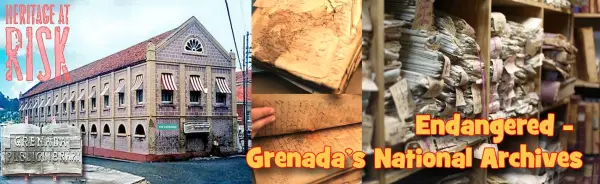
Showing posts with label Grenada National Archives. Show all posts

16 Apr 2015

Grenada's Endangered Archives

Caribbean archives under threat: Grenada

Unbeknownst to almost any Grenadian a submission was put to Unesco for funding towards the further “Digitizing and Preservation of Grenada’s National Archives” and in July of 2014 Unesco approved a tiny sum of US$22,000.

Back in June 2012, a year after Grenada’s National Archive official closure (though it hadn’t functioned since 2004), a group in Reading (UK) known as the “Diasporic Literary Archives Network” (diasporicarchives.com), headed by Alison Donnell (Professor at the University of Reading), held a two-day opening Workshop on the “Questions of Location, Ownership and Interpretation“. At this workshop a presentation was given by Merle Collins and Alison Donnell which bought a good deal of attention to the situation of archives caught up in problems of a material and political nature, such as Grenada’s not having at the moment an accessible building for its archive.

The group continued discussions about how best to work with and support local initiatives to improve library and archival facilities in Grenada. On behalf of the Network, David Sutton sent an expression of support that was warmly received by Minister Franka Alexis-Bernardine.

At the same time Merle Collins announced the establishment of a not-for-profit organization called Grenada Libraries, Archives and other Heritage Support Group (GrenLib), that could raise awareness and funds in the diaspora. Articles have been drawn up with signatories in Grenada, New York and Washington. An inaugural fundraising event, Grenada Cultural Extravaganza, was held in New York in November 2013.

A “Grenada Library and Archives Committee”, organized from within Grenada, was purportedly established with both Merle Collins and Alison Donnell as members with one meeting to date. Ms Collins talked to her international Grenada diaspora organization which has members from Canada, the U.K. and various parts of the U.S.A, and Grenada’s Diaspora Office.

Follow-up work took place at the Caribbean Studies Association 38th Annual Conference in Grenada in June 2013, were Lillian Sylvester (Director of Libraries, Grenada Library Services), Collins and Donnell presented a panel on “Valuing the past: libraries, archives and the ‘development’ of literary culture in the Anglophone Caribbean” which focused special attention on Grenada.

Two years later, in 2014, Glenlib held their first annual “Diaspora Give-Back Fundraising Event” at the University of Maryland with the Friends of Grenada Library, Archives and other Heritage Committees.

In September that year another Workshop was held in which Cheryl Sylvester (Faculty Librarian at St George’s University) highlighted the situation in Grenada:
…it is not just a shortage of professional expertise that prevents full exploitation of archival material, but the fundamental absence of a building suitable for housing a national library and archives since the damage caused by the hurricane of 2004. A transnational campaign to replace the former Public Library, supported by the Friends of Grenada Library, Archives and other Heritage Committee (GRENLIB), is attempting to fundraise for a new building, but for Sylvester, a higher level of government commitment is required if the building is ever to become a reality.
Whilst there remains no national archive building in Grenada important holdings remain at risk of being lost, stored in inadequate conditions and liable to environmental degradation.

Further, at the Society of American Archivists’ August 2014 Issues & Advocacy Roundtable (IART), Ms Sylvester discussed the “Threat to national archives and library in Grenada” and reported:
  • Since 2011, the library/archives building has been closed, with the collection stuck inside, and the collection (including records of the 1983 American invasion) is at risk
  • Library building was already in a state of disrepair when Hurricane Ivan did further damage in 2004; archives on top floor was damaged (shelves are being eaten away by termites)
  • In the meantime, political supporters of the library lost power
  • The previous Minister of Education sought several alternative locations, didn’t work out because of internal wranglings
  • There’s been a change in government, but the situation remains the same
  • Director of Libraries role is uncertain – unclear whether the government still considers the role to be active
  • A request to the SAA that they consider joining other international information
    professional organizations (ICA, Association of Caribbean Academic Libraries, etc.) in writing to the Minister of Education, who has responsibility for libraries and archives
  • Other advocacy efforts related to this issue:
    • last year, a paper was presented at the CARBICA conference about archives that need attention
    • In March 2014 a paper was written on the state of archives in Grenada
  • Next steps: Sarah Quigley said I&A would be glad to draft a letter and send it to our SAA Council Rep (and the appropriate SAA committees), remembering the SAA had already donated through CARBICA US$1,000 back in March 2005 to the Grenada Archives Mission.
In its 2015 mandate on “Caribbean archives in the Caribbean: a new future” Alison Donnell (DLAN), said the group is committed to finding ways of sustaining and supporting this work into the future. The Network expects also to continue its solidarity work with archivists in Grenada in 2015 and beyond.

In January 2015 at the “Politics of Location” workshop held at Yale, Helena Leonce (Trinidad Archivist) gave an update in which she stated “The Caribbean region has embarked on a number of digital initiatives, in an attempt to keep abreast with the technological advances that are taking place in the world. Plans to digitize literary archival material have also been given great consideration.”
The DLAN’s principal investigator (and Director of Research Projects in the University of Reading Library since 1982), David Sutton, reiterated what Cheryl Sylvester had told him about the situation of Grenada’s National Archives:

A digitization project has been started which is on-going. This project was initiated by the UNESCO Secretariat through IFAP. The aim is to digitize old records at the library.
Progress Report
  • Government gazettes from 1880’s to 1920 are completed;
  • West indian chronicle 1880’s to 1890’s with gaps;
  • Blue books 1900’s & colonial letter registers from 1800’s begun.
Also an attempt was made with the Alister Hughes newsletters and the revolutionary documents at the fort were nominated for Unesco ‘Memory of the World’ registers but this clearly failed because the newsletter had already been digitized on DLOC (Library of Congress website) and so is therefore no longer under threat.

The Revolutionary documents have to be cleaned and inventoried so that proper documentation can be carried out to enable their digitization.

However Cheryl Sylvester completely overlooked the US$60,000 work that Dr Laurence Brown team from University of Manchester had initiated in 2010 with the help of “Endangered Archives Project” of The British Library and completed in February 2014 which had 2500 pages of twelve volumes digitized material at the Supreme Court Registry (from 132 identified).

[See Grenada's Endangered Archives (part 6)]


Remember to check out the latest by joining our Facebook Group at Grenada’s Endangered Archives
« Prev Page | Next Page »
3 Mar 2015

Grenada's Endangered Archives

Update: Grenada National Archives – New hope

Today (3rd March 2015) Grenada’s Information Service (GIS) informs us that:

The University of the West Indies (UWI) has “brushed aside suggestions that the Keith Mitchell administration is to be blamed for the delay in the Open Campus project in Hope St. Andrew“.
Principal of UWI Open Campus (Grenada) Eudine Barriteau made the disclosure in St. George’s after presenting our political cabinet with a proposal for the project.

Claims that the current government was delaying the project have been attributed to opposition sources.
“The feedback is that the cabinet is supportive of the project as we have in fact anticipated, so if they are any misconceptions that there was a delay coming from the government that is totally incorrect”, Barriteau said.

The UWI Open Campus Principal told local journalists that the search for a reliable architect firm was the cause of the delay.
“In fact what was the delay…the Open Campus needed a partnership with a reliable quantity surveying architectural firm and we found that partnership with a firm out of Trinidad and Tobago that has expertise in engineering”.

The Open Campus project in Hope involves two phases during construction.

To us the most significant fact is that the first “Phase A”, which features the construction of administration offices, classrooms, and early child centres, the phase also promises the construction of a National Archives.

Professor on gender and public policy, Violet Eudine Barriteau who is Pro-Vice Chancellor had assumed office as Principal of our University of the West Indies Open Campus (Grenada) on 1st August 2014 (having succeeded then Pro Vice-Chancellor Professor Hazel Simmons-McDonald). Now she has successed Hilary Beckles as new Principal of UWI (Cave Hill, Barbados) from 1st May 2015.

The 60 year old professor Grenadian by birth, with a distinguished record as a Caribbean scholar and administrator, Professor Barriteau has served in various roles at The University of the West Indies for more than 30 years. She holds a PhD in Political Science from Howard University, an MPA in Public Sector Financial Management from New York University and a BSc, Upper Second Honours in Public Administration and Accounting from The University of the West Indies. She also holds a professional certificate in editing and scholarly publishing from the International Rice Research Institute in Los BaƱos, the Philippines.


Remember to check out the latest by joining our Facebook Group at Grenada’s Endangered Archives
« Prev Page

2 Aug 2014


Grenada's Endangered Archives

Grenada’s endangered archives programme (EAP295)

Update: Grenada National Archives – New access

Wonderful news – the link from the British Archive’s Catalogue to our Endangered Digital Collection is now live (as of 01 Aug 2014). So, for example, on this page http://bit.ly/1q8e2tt , click on ‘Browse this collection’. On the new page, you can now click ‘View digital version’.


This is the British Library Catalogue search screen. Using the referecnce to one of our Endangered Archives series, “EPA295/2/6/1″ for example, we can then see the option to “Browse this collection”…


You will then be taken to this screen listing our “Endangered Archives Programme” collection held on the British Library service. As you can see you are now able to “View digital version” of the collection.


Here is the screen showing the thumbnails and actual JPEG images* of the scanned archives. In this case one of the 82 pages of the “Court of Oyer and Terminer for Trial of Attained Traitors record book” for 1796 from the “Collection of court records held by the Grenada Supreme Court Registry” for 1765-1797. Reference EAP295/2/6/1.

Note: The "JPEG" imaging standard is an acronym for the Joint Photographic Experts Group (defined in RFC 1341) a commonly used method utilizing a lossy compression for digital images. This compression inherently degrades the actual quality of the image, therefore loosing vital detail information. More commonly, images created by digital cameras are now recorded in the RAW (unprocessed) image format based on the ISO 12234-2 standard (or TIFF/EP). Although not confirmed we believe the BA has the original images in RAW format.

Remember to check out the latest by joining our Facebook Group at Grenada’s Endangered Archives
« Prev Page | Next Page »

25 Jul 2014


Grenada's Endangered Archives

Grenada’s endangered archives programme (EAP295)

Update: Transcription from Grenada’s Archives Published

Dr Laurence Brown (University of Manchester) has published a 73 page transcription of images from “Court of Oyer and Terminer for Trial of Attained Traitors record book 1796” [part of Grenada’s endangered archives digitised series EAP295/2/6/1]. It includes notes, the transcription and an alphabetical list of names from 1796.


[eap295_2_6_1_transcription.pdf]
Download

Note: A page is missing between 037 and 038 (it was never copied). It containes trial information for 8th August 1796.

Remember to check out the latest by joining our Facebook Group at Grenada’s Endangered Archives
« Prev Page | Next Page »
31 Jan 2014


Grenada National Archives - Protection, conservation, access

The threat to archives -
Documentary heritage reflects the diversity of languages, peoples and cultures. It is the mirror of the world and its memory. But this memory is fragile. Every day, irreplaceable parts of this memory disappear for ever.
UNESCO Memory of the World Programme.

Ric Greaves on histories in peril

Sadly very little protection or conservation has been undertaken by Grenada and reconstructing this important and endangered archive relies heavily on a 1968 document produce by E. C. Baker’s called A Guide to Records in the Windward Islands.  Thankfully the Endangered Archived Project number 295, undertaken by the British Library (with the financial support of Arcadia) has now managed to give us ‘access’ to at least some 4500 digital images from our existing archives.

Back in 2009 the British Library (with the financial support of Arcadia) began an US$64,000 project to protect and disseminate historical records of pre-industrial societies such as our own.

This British Libraries EAP was part of the US$18.0 million awards of some 41 research grants for records throughout the world, including the Caribbean, which are fast disappearing through neglect, physical deterioration or destruction - the Endangered Archives Programme is aimed at safeguarding some of this documentary heritage world-wide. The entire programme now has over one million images available online!  They have new online collections every month which has taken the total number of images available in our collections over this one million mark. These collections come from India (EAP201), Lesotho in Southern Africa (EAP279), Mongolia (EAP529) and finally our own Grenada (EAP295).

Although 132 volumes of deed records and local government correspondence were identified in Grenada, the EAP295 Project had to remain modest in conception and rooted in practicality – it was not aimed at promoting theoretical advances in archival management or cutting-edge technology in digital preservation – it was about quick achieving result on the ground.

Project EAP295 began with two weeks of digital photography under a team from the University of Manchester led by Dr Laurence Brown and photographer James W Robinson which took place in November 2010.  This was only a part of the unique historical archives of our island, material which provides a micro-vision of how Grenada was transformed in the late eighteenth century by imperial conflicts, the expansion of plantation slavery and revolutionary politics.

The two main sources of records are from Government House and the Supreme Court. The Supreme Court records reveal the multi-racial alliances and conflicts that marked slave society while the Government House correspondence shows the local negotiations and conflicts that shaped the prolonged transition to a free society during the mid-nineteenth century.

During Hurricane Ivan in 2004 the Grenada Public library (our National Archives) lost part of its roof and the Government House correspondence became displaced and out of order. There was no item-level index of this material so series P material needed to be ordered chronologically then digitisation focused primarily on those works which were seen as the most fragile due to their age or unbound condition. This greatly hampered the project which needed to have material chronologically reordered before digitising could take place.

The project focused on digitising just twelve volumes and files of Governor and Lieutenant-Governor’s correspondence covering the period 1764-1879 and the Letter Books of the Administrator and Colonial Secretary (series P) because these were far more fragmented than the Governor’s correspondence.

The material at the Supreme Court Registry was far better preserved than at Government House as it was relatively unaffected by Hurricane Ivan. Loose-leaf documents previously identified as connected to the eighteenth century French Deeds formed the initial focus of in situ digitisation in the Supreme Court Registry. Many of the bound volumes of French Deeds identified by the project required such extensive preservation and conservation work that their digitisation would have destroyed their physical structure. By stabilising their storage and digitising those materials in the Supreme Court Registry which were already fragmentary or fragile, the project was able to make a significant step towards its original aims.

Digitisation also continued in the Supreme Court Registry on the Births, Deaths and Marriages Registers for St Georges and records related to Forfeited Estates, 1794-1802. During this time one of the Archival researchers employed by the project cleaned, sorted and ordered the French Deed bound volumes and unbound materials.

The material at the Supreme Court Registry was far better preserved than at Government House as it was relatively unaffected by Hurricane Ivan in September of 2004. Loose-leaf documents previously identified as connected to the eighteenth century French Deeds formed the initial focus of in situ digitisation in the Supreme Court Registry.  Digitisation also covered some of the Births, Deaths and Marriages Registers.
1 Image 3

A total of 4589 pages were finally digitised, indexed, catalogued and a full list of digitised documents now available online are:

EAP295/1
"Holding of Government House are listed in Baker (1968), pp. 14-18. After Hurricane Ivan, around half this material has survived, with particularly heavy loses of documents from the late 1800s and first half of the twentieth century. Digitisation focused on the earliest surviving records of Government House”.


EAP295/1/2
"Holding of Government House are listed in Baker (1968), pp. 14-18. After Hurricane Ivan, around half this material has survived, with particularly heavy loses of documents from the late 1800s and first half of the twentieth century. Digitisation focused on the earliest surviving records of Government House”.

EAP295/2
The earliest family records held by the Grenada Supreme Court Registry is for the French period 1762-1785.

Unbound French legal document.
These boxes of unbound French legal documents was reconstituted by Dr Curtis Jacobs (UWI Grenada)


Note: Arcadia is a grant-making fund established in 2001. Lisbet Rausing and Peter Baldwin form the Donor Board. Peter Baldwin is Chair of the Donor Board. The fund was formerly the Lisbet Rausing Charitable Fund. As of September 2013 Arcadia had awarded grants of more than $243 million.

Grenada's Endangered Archives

Grenada’s endangered archives programme (EAP295)

Update: Grenada National Archives – Protection, conservation, access

The threat to archives –
Documentary heritage reflects the diversity of languages, peoples and cultures. It is the mirror of the world and its memory. But this memory is fragile. Every day, irreplaceable parts of this memory disappear for ever.
UNESCO Memory of the World Programme.
Ric Greaves on histories in peril

Sadly very little protection or conservation has been undertaken by Grenada and reconstructing this important and endangered archive relies heavily on a 1968 document produce by E. C. Baker’s called A Guide to Records in the Windward Islands.  Thankfully the Endangered Archived Project number 295, undertaken by the British Library (with the financial support of Arcadia) has now managed to give us a little ‘access’ to at least some 4500 digital images from our existing archives.
Back in 2009 the British Library (with the financial support of Arcadia) began an US$64,000 project to protect and disseminate historical records of pre-industrial societies such as our own.

This British Libraries EAP was part of the US$18.0 million awards of some 41 research grants for records throughout the world, including the Caribbean, which are fast disappearing through neglect, physical deterioration or destruction – the Endangered Archives Programme is aimed at safeguarding some of this documentary heritage world-wide. The entire programme now has over one million images available online!  They have new online collections every month which has taken the total number of images available in our collections over this one million mark. These collections come from India (EAP201), Lesotho in Southern Africa (EAP279), Mongolia (EAP529) and finally our own Grenada (EAP295).

Although 132 volumes of deed records and local government correspondence were identified in Grenada, the EAP295 Project had to remain modest in conception and rooted in practicality – it was not aimed at promoting theoretical advances in archival management or cutting-edge technology in digital preservation – it was about quick achieving result on the ground.

Project EAP295 began with two weeks of digital photography under a team from the University of Manchester led by Dr Laurence Brown and photographer James W Robinson which took place in November 2010.  This was only a part of the unique historical archives of our island, material which provides a micro-vision of how Grenada was transformed in the late eighteenth century by imperial conflicts, the expansion of plantation slavery and revolutionary politics.

The two main sources of records are from Government House and the Supreme Court. The Supreme Court records reveal the multi-racial alliances and conflicts that marked slave society while the Government House correspondence shows the local negotiations and conflicts that shaped the prolonged transition to a free society during the mid-nineteenth century.

During Hurricane Ivan in 2004 the Grenada Public library (our National Archives) lost part of its roof and the Government House correspondence became displaced and out of order. There was no item-level index of this material so series P material needed to be ordered chronologically then digitisation focused primarily on those works which were seen as the most fragile due to their age or unbound condition. This greatly hampered the project which needed to have material chronologically reordered before digitising could take place.

Just Twelve Volumes Rescued

The project focused on digitising just twelve volumes and files of Governor and Lieutenant-Governor’s correspondence covering the period 1764-1879 and the Letter Books of the Administrator and Colonial Secretary (series P) because these were far more fragmented than the Governor’s correspondence.

The material at the Supreme Court Registry was far better preserved than at Government House as it was relatively unaffected by Hurricane Ivan. Loose-leaf documents previously identified as connected to the eighteenth century French Deeds formed the initial focus of in situ digitisation in the Supreme Court Registry. Many of the bound volumes of French Deeds identified by the project required such extensive preservation and conservation work that their digitisation would have destroyed their physical structure. By stabilising their storage and digitising those materials in the Supreme Court Registry which were already fragmentary or fragile, the project was able to make a significant step towards its original aims.

Digitisation also continued in the Supreme Court Registry on the Births, Deaths and Marriages Registers for St Georges and records related to Forfeited Estates, 1794-1802. During this time one of the Archival researchers employed by the project cleaned, sorted and ordered the French Deed bound volumes and unbound materials.

The material at the Supreme Court Registry was far better preserved than at Government House as it was relatively unaffected by Hurricane Ivan in September of 2004. Loose-leaf documents previously identified as connected to the eighteenth century French Deeds formed the initial focus of in situ digitisation in the Supreme Court Registry.  Digitisation also covered some of the Births, Deaths and Marriages Registers.

1 Image 3

A total of 4589 pages were finally digitised, indexed, catalogued and a full list of digitised documents now available online are:

EAP295/1
“Holding of Government House are listed in Baker (1968), pp. 14-18. After Hurricane Ivan, around half this material has survived, with particularly heavy loses of documents from the late 1800s and first half of the twentieth century. Digitisation focused on the earliest surviving records of Government House”.
EAP295/1/2
“Holding of Government House are listed in Baker (1968), pp. 14-18. After Hurricane Ivan, around half this material has survived, with particularly heavy loses of documents from the late 1800s and first half of the twentieth century. Digitisation focused on the earliest surviving records of Government House”.
EAP295/2
The earliest court records held by the Grenada Supreme Court Registry is for the period 1762-1785.
Unbound French legal document.

Note: Arcadia is a grant-making fund established in 2001. Lisbet Rausing and Peter Baldwin form the Donor Board. Peter Baldwin is Chair of the Donor Board. The fund was formerly the Lisbet Rausing Charitable Fund. As of September 2013 Arcadia had awarded grants of more than $243 million.


Remember to check out the latest by joining our Facebook Group at Grenada’s Endangered Archives
« Prev Page | Next Page »

14 Jan 2014

Grenada's Endangered Archives
The newyear begins and we hear that Pranical Technologies and UNESCO, through the Communication & Information Sector, informs us that the IFAP plans to protect historical documentary resources on Grenada.

Archives damaged by the effects of termites,
Grenada National Library, St. Georges

The Intergovernmental Information for All Programme (IFAP) has recently launched an information preservation project in Grenada, which is helping to protect valuable and rare historical documentary resources. The project is also providing useful experiences that can inform actions in other Small Island Developing States (SIDS). It is one of several initiatives undertaken in the Caribbean during the 2012-2013 biennium with the financial support of UNESCO’s Multi-donor Emergency Fund.

According to Jasmin Garroway, from the National Commission in Anguilla (UNESCO’s newest Associate Member),
the project undertaken in Grenada provides important technical insights that are an inspiration for the members of the National Memory of the World Committee, which is being established“.

Insights into the complex political, social and economic changes that have transformed Grenada over the past 300 years can be found in its national archives. But today, this archival heritage, which managed to survive the military exploits during the colonization of the new World and the more recent Cold-war era, is now threatened by inadequate storage and natural causes.

Hurricane Ivan, which hit the island in 2004, compromised the main library and the national archives. As a result, these collections were dispersed to makeshift emergency storage areas. The limited resources available to the Government, the need to respond to other more urgent human needs, as well as the inadequacy of what was only intended to be temporary storage has seen these precious resources become endangered.

Recently, the Government launched a ‘major effort‘ (sic) aimed at obtaining finances to restore the public library and protect its archives, but even as these plans are being put in place, the ravages of humidity and termites continue their assault on the fragile materials.

Discussions between the IFAP Secretariat and the official Delegation of Grenada during UNESCO’s 37th General Conference helped to identify some immediate interventions that could forestall this degradation. A project was conceived to train government staff and local volunteers in inventorying the archives, relocating them into more favourable locations, protecting them from termites and humidity as well as acquiring equipment to support the digitization of the archives.

N.B. None of the aforementioned consultants of the delegation have been named and ‘training governmental staff and volunteers‘ is a feeble response to the urgency of our plight, and we fear who these ‘information professionals‘ are – still this small response is better than the previous decade of no response.

Joan-Marie Coutain, Secretary-General of the Grenada National Commission, says,
Within the space of a few weeks, our discussions with UNESCO were transformed into a proposal that was then concretely implemented on the ground. We now have young trained Grenadian volunteers working under the guidance of government information professionals and using the equipment acquired for this project to save our documentary treasures.

The intergovernmental Information for All Programme was established in 2001. It provides a platform for international policy discussions, cooperation and the development of guidelines for action in the area of access to information and knowledge. The Programme also supports Member States to develop and implement national information policy and strategy frameworks.

James Gill's photo.


Remember to check out the latest by joining our Facebook Group at Grenada’s Endangered Archives
« Prev Page | Next Page »

10 Jan 2014


In our continuing series on capturing Grenadian heritage we look at – David Hedog-Jones.
By Ric Greaves 18 Oct 2013

David Hedog-Jones (c1875-1942)

Grenadian School Headmaster; WWI Captain; African School Headmaster; and Vicar.


Margaret Edith (nƩe Martin) with her new husband David Hedog-Jones,
Captain in the British West Indian Regiment, on their wedding day 29th of July 1916.

David Hedog-Jones was probably born not far from Hedog in Gwynedd North Wales, close to Aberdaron, sometime in the 1870's, however his birth and marriage details have currently not been found.

Unfortunately we know almost nothing of his early life and indead exactly how how he came to be in Grenada.

We do know that in 1910 he earned his National Diplomas (B.A., B.Sc.) in Dairying from the University College of Wales (Aberystwyth) and the British Dairy Institute, Reading and must of took up the post of Headmaster a Grenada Boy's Secondary School (GBSS) in Grenada immediately.

The GBSS was founded as a fee-paying school back in 1885 by the Cocoa and Sugar planters of the island for their children and followed the English grammar school style of education.  However, the Colonies were looking to develop education throughout the empire and at about this time the school was reorganized and reopened at the renovated premises on Melville Street, Saint George's as a free government school with between seventy and eighty boys on the 18th of September 1911.

In 1912 David, as Headmaster of GBSS, published his paper on "Agricultural Education in Grenada".  It illustrated the difficulty he and Grenadian schools in general had with the development of vital education in the field of agriculture.  The paper dealt with the importance of agricultural education on the island in its various aspects as consideration on the part of authorities in the West Indies, during the previous decade, particularly the work of the Imperial Department of Agriculture.  At the time attempts had been made to introduce rural teaching into Grenada elementary schools, the main purpose of the paper was to show how the re-constituted secondary school in that island would be made to bear relationship to the island in general and to the agricultural community in particular.  It seams, however, that he failed in attempts to introduce nature study as a useful subject, into Grenada elementary schools.  The lack of requisite and sympathetic knowledge on the part of teachers in the schools — a condition due specifically to the fact that lectures given to such teachers in the in the earlier years were not followed up by further courses.  The enthusiasm first engendered soon waned, and a few years later it was proposed that grants should be curtailed in the case of schools that did not use their agricultural plots.  The matter began to be serious toward 1907, and since that time the agricultural plot were finally literally abandoned.


This was followed by his attendance to the eighth West Indian Agricultural Conference held in Jamaica in January that year and prompted his 71 page paper entitled the same.

Meanwhile his experiences in Grenada promoted his drive to understand the origin, the behavior, and the physical, social, and cultural development of the islands people - leading his to attain another M.A. from Jesus College at the University of Oxford in 1914.  This led to his next two books "Glimpses of the Caribbees and Elsewhere" and "West Indian Studies" which look into folk lore, religion, magic, agricultural conference, and glimpses of the Caribees.


Unfortunately on the 28th of July of that year, just one month after the Austrian Archduke Ferdinand and his wife are assassinated by the student Gavrilo Princip, the world was thrown into the horrors of our First World War and the estimated casualties of 37 million men which included 8.5 million deaths.  A dark cloud is looming over everyone in the British Colonies and would soon reach the Caribbean and Grenada...

In April of 1915 David encourages the GBSS to published a school magazine, "The Caribbean" which outlines the progressive work school and he himself submits an article on agricultural education in Grenada emphasizing the necessity of bringing the teaching of the primary schools into a more direct connexion with that of the secondary school.  The following year the magazine contained an interesting collection of folklore and brings out the striking characteristic of West African folklore, namely, the strong personification of animals, particularly the spider and also a list of West Indian proverbs.


David had met Margaret Edith (born in 1876 in Sunderland, Durham, England), she was the daughter of Canon Henry Martin.  It wasn't too long before the couple had a son, David Henry James who went on also to have gain an M.A., have a military career as Flight Lieutenant in the Royal Air Force, receive an M.B.E, and become a Councillor in 1966 and Mayor of Cheltenham (England) by 1974.

Lt. David D. H. J. Martin-Jones


With the war looming many young couples felt a more urgent need to make their commitment to each other more permanent and likewise David married Edith on the 29th of July 1916. 

However with the heavy rains of October 1916, the looming war began calling more of it's children to fight and David had to leave the GBSS and join up.  His departure was noted as follows:-
"Owing to the departure of Mr. Hedog-Jones, science teaching at the Grenada Boys' School is in abeyance. This has caused delay in the beginning of work under the new agricultural cadetship scheme".


On the 29th of November 1916 Captain David Hedog-Jones of the Grenada Volunteer Force takes up his position as Temporary Lieutenant of the Fifth Battalion of the British West Indian Regiment.

By the May of the following year he is made Temporary Captain in the Oversea Contingent of the BWIR.  Like all staff officers he was in the classification FF which denoted gradings for War Office posts for pay and allowances of up to £400 per annum.

Finally by in August of 1919 Captain C. H. Burke relinquished his rank, David was obliged to take up the position of Temporary Major.

During the end of 1917 their second child, daughter Edith is born in Great Ouseburn, Yorkshire (England).

We haven't, as yet, found the records of his war career but we do know that when in February of 1920 David was in Haifa, Palestine on the staff of the Department of Agriculture at a time when the first of two large political demonstrations took place proceeding the events of Easter weekend David was very much there and wrote:-
"...in the absence of both police and soldiers, the breaking open of shops in the New Bazaar, and looting was absolutely unrestrained".
The war over, officially David relinquished his rank of Temporary Major two years later in October of 1920.  At about this time he became a member of the Palestine Oriental Society and Society of Cymmrodorion.

As with many soldiers of that period it is evident that the war had a profound effect on David.  Most certainly with the influence and support of Margaret Edith he turned to religion and became a Vicar and in 1923 the family are living at the Kelloe Vicarage in Coxhoe, Durham (England).

At some point in 1923 David was invited by Hugh Clifford to take up a post as the Organiser of Practical Education to control the Trade Schools in Accra on the Gold Coast and he and Margaret travelled by ship to Ghana, Africa.  He was there to aid with the development of education in Accra as Headmaster and member of the ‘European’ (as apposed to African) staff of the four JUNIOR TRADE SCHOOLS, which consisted of three other headmasters Lieut.-Col. E. St. J. Christophers (deceased by 14 Feb 1924), D.S.O., Captain H. G. Ardron, Captain A. Drake. Brockman, and one relief headmaster). The African staff were four each of Woodwork, Metalwork, Masonry, Agricultural and Literary instructors.

Although he took five months leave in the second half of that first year he spent the whole of the next two years there teaching and developing the schools.  He wrote a short report on the four Junior Trade Schools on the 17 Aug 1925.  They were all, at the time, in temporary buildings one for the Eastern Province (Kibi with 72 pupils), the Central and Western Provinces (Assuantsi, 60 pupils),Northern Territories (Yendi, 90 pupils), and one for the Ashanti (Mampong, 60 pupils.  This later school was originally ministered by Elizabeth W Telfer as headmistress in charge of the Province until, April 12th when she left and David then took charge, and he was required to combine the duties of Acting Provincial Inspector of Schools and Headmaster of the Junior Trade School, Mampong. until she returned on October 1st.

Rev. David and Margaret Edith returned to England some time before 1929 when the family moved to the Brookthorpe Vicarage, near Gloucester (England) where they remain for some ten years.  Then in March of 1932 he was the Incumbent of the Benefice of Brookthorpe with Whaddon where he was on the Toddington Parish Council with Margaret Edith.


The former educator of the Grenada Boy's Secondary School passed away whilst at home in
Ewesham Road, Toddington near Cheltenham (England) on Tuesday 24th of March 1942.

Ten years later David's son married a member of the Grimsby family of Lincolnshire (England) and county tennis player, Miss Susan Anningston Tickler, daughter of the late Mr Harry Tickler, at St James' Church on the 7th of July 1952.  And Margaret Edith lives almost another two decade and died as a widow aged 84 on the 24th of November 1960 in the family home.


References

  • D. Hedog-Jones, “Agricultural Education in Grenada, with Special Reference to the Secondary School for Boys”, West Indian Bulletin, vol. 12-13, 1912, p.221
  • D. Hedog-Jones, "A West Indian Agricultural Conference", 1912, pp.71
  • D. Hedog-Jones, "Glimpses of the Caribbees and Elsewhere", 1914, pp.97
  • The Agricultural News, vol. 14, no. 338, 1915, p.124
  • The Agricultural News, vol. 15, no. 358, 1916, p.44
  • D. Hedog-Jones, "West Indian Studies", 1916, pp.97
  • Ed., D. Hedog-Jones, "The Caribbean", vol. 1, 8vo., 1916
  • The London Gazette, Issues 30295 to 32127
  • Palin report, British National Archives (FO 371/5121)
  • Gloucestershire Echo, 1942, p.4
  • Cheltenham Chronicle, 1942, p.6
  • C. L. Joseph, “The British West Indies Regiment 1914–1918″, Journal of Caribbean History, vol. II, May 1971, pp. 94–124

1 Jan 2014

The British West Indies Regiment

IWM
Three lads of the British West Indies Regiment
The regular West India Regiment long pre-dated the “Great War” and its 1st Battalion, based at Freetown, sent a detachment for service in German Cameroons. 2nd Battalion saw much service in the West and East African campaigns and then went to Palestine in September 1918.

The so called “Great War” or World War I, covering the four years of 1914 to 1918, began in central Europe in late July 1914, and though it’s causes included many churlish factors – such as the conflicts and hostility between the larger European powers of the four decades leading up to the war – militarism, alliances, imperialism, and nationalism played major roles in the conflict that ended in throwing away the lives of millions of young men – not for what the bileived to be true and good but for a select few who beleived their power was under threat. The immediate origins of the war, therefore, lay in the decisions taken by statesmen and generals during the “July Crisis” of 1914 caused by the assassination of an Archduke, Franz Ferdinand, and his wife Sophie by the Surbian student Gavrilo Princip, an irredentist member of a Serbian nationalist organization called Black Hand.
Following the outbreak of these hostilities in 1914 many West Indians left the colonies to enlist in the army in the UK and were recruited into British regiments. However, the War Office was concerned with the number of black soldiers in the army and tried to prevent any people from the West Indies enlisting. Indeed, the War Office threatened to repatriate any who arrived. Eventually, after much discussion between the Colonial Office and the War Office, and the intervention of King George V, approval to raise a West Indian contingent was given on 19 May 1915. On 26 October 1915 the British West Indies Regiment was established.
The creation of the British West Indies Regiment, passed on 3 November 1915, was formalised by Army Order number 4 of 1916. The Order stated that the regiment would be recognised as a corps for the purposes of the Army Act.

Battalions formed by this regiment

1st Battalion
Formed at Seaford, Sussex, England from West Indies volunteers: A Company from British Guiana, B from Trinidad, C from Trinidad & St. Vincent, D from Grenada & Barbados.
Served in Egypt and Palestine.
War diary September 1915 – April 1919 (WO95/4427, 4433, 4410, 4732)
2nd Battalion
Served in Egypt and Palestine.
War diary January 1916 – April 1919 (WO95/4427, 4433, 4732)
3rd Battalion
Served in France & Flanders.
War diary March 1916 – January 1919 (WO95/4465, 338)
4th Battalion
Served in France & Flanders.
War diary May – November 1918 (WO95/409)
5th Battalion
A reserve draft-finding unit .
War diary July 1916 – April 1919 (WO95/4465)
6th Battalion
Served in France & Flanders.
War diary March 1917 – April 1919 (WO95/495)
7th Battalion
Served in France & Flanders.
War diary June – December 1917 (WO95/409)
8th Battalion
Served in France & Flanders and went to Italy in 1918.
War diary July – December 1917 (WO95/338)
9th Battalion
Served in France & Flanders and went to Italy in 1918.
War diary July – December 1917 (WO95/338)
10th Battalion
Served in France and Italy.
11th Battalion
Served in France and Italy.

Pic
The regimental badge as depicted by CWGC on the gravestone of Pte 13576 Phillip Byles of the 10th Battalion. He now lies in Longuenesse Souvenir Cemetery near St Omer in France. Author’s collection.

The contribution of the West Indies

A total of 397 officers and 15,204 men, representing all Caribbean colonies, served in the BWIR. Of the total, 10,280 (66%) came from Jamaica. Athough at least 380 men served in this war from Grenada, they had joined many regiments all over the globe (primarily throughout the USA).
In addition contributing to the British West Indies regiment, Bermuda raised two more contingents: the Bermuda Volunteer Rifle Corps (which was attached to the 1st Lincolnshire Regiment) and the Bermuda Garrison Artillery. Other men joined other British and Canadian regiments; some quite possibly joined the United States army too but we have yet to confirm this.

Further reading

  • F. Cundall, Jamaica’s Part in the Great War, 1914–1918 (Institute of Jamaica, 1925)
  • Guy Grannum, Tracing Your West Indian Ancestors (PRO Publications, 2002)
  • C. L. Joseph, “The British West Indies Regiment 1914–1918″, Journal of Caribbean History, vol. II, May 1971, pp. 94–124
  • Richard Smith, Jamaican Volunteers in the First World War (Manchester University Press, 2004)
  • J. A. P. M. Andrade, A Record of the Jews in Jamaica: From the English Conquest to the Present Time (Jamaica, 1941). This includes a list of the Jewish members of the Forces who were from Jamaica, who served during the First World War (not all of whom served with the BWIR).
  • The list of the first 380 Grenadian men aged 14 to 40 who left for the US, UK, Canada and Austrailia shortly before WW1 and then joined up, G.N.A, 1920, pp.4.

12 May 2013


Grenada's Endangered Archives

Digitising the endangered archives of Grenada (EAP295)

As of May 2013 Cathy Collins (EPA Grants Administrator @ Endangered Archives, The British Library, London, UK) wrote:
I am afraid the results from this project are still being finalised so the records have not yet been catalogued or made available online. However, I am optimistic that the last few remaining queries should be sorted out without too much delay now.

Project Outcome – four years on

Before this project, the material from Government House that had survived the 2004 hurricane had been deposited in the basement of the Office of the Governor-General but there was no index, or order to the material. In totally reconstructing this archive the project relied heavily on E. C. Baker’s A Guide to Records in the Windward Islands (1968). All our Government House material was cleaned, repaired, placed in chronological and thematic order and indexed.

Twelve volumes and files of Governor and Lieutenant-Governor’s correspondence were digitised covering the period 1764-1879. The Letter Books of the Administrator and Colonial Secretary were digitised as series P because these were far more fragmented than the Governor’s correspondence. Without an item-level index of material dating from before the 2004 hurricane (Ivan), series P material has been ordered chronologically and digitisation was focused on those works which were seen as the most fragile due to their age or unbound condition.

The material at the Supreme Court Registry was far better preserved than at Government House as it was relatively unaffected by Hurricane Ivan. Loose-leaf documents previously identified as connected to the eighteenth century French Deeds formed the initial focus of in situ digitisation in the Supreme Court Registry. Many of the bound volumes of French Deeds identified by the project required such extensive preservation and conservation work that their digitisation would have destroyed their physical structure. By stabilising their storage and digitising those materials in the Supreme Court Registry which were already fragmentary or fragile, the project was able to make a significant step towards its original aims.

Digitisation

Aside from preservation and restoration – THE most important aspect and concern for this endangered project is with the dititisation and immediate onine access and availablility of our historical records.

Digitisation has continued in the Supreme Court Registry on the Births, Deaths and Marriages Registers for St Georges and records related to Forfeited Estates, 1794-1802. During this time one Archival researcher employed by the project has attempted to clean, sort and order the French Deed bound volumes and unbound materials.

Most significantly copies of all digitised material have been deposited with the British Library. Further copies have been placed with the University of the West Indies, Grenada campus, and this is supposed to be made publically accessible through the new campus that is being constructed on the island. We will just have to hold our breath and wait.

Copies of all digitised material will also be deposited with our Grenada National Archives … when this is too is constructed.

I’m sorry to say that four years has now passed since the project took place and we still await physical access to this virtual data but as seem Grenada’s lot we must wait and see…
Keep up with the Archives News on our page “Grenada’s Endangered Archives” at http://www.facebook.com/groups/158188037685838/
James Gill's photo.
Although back on the 27 September 2013 the Grenada Information Services (GIS) and Education and Human Resource Development of Grenada announce:- 
The Library will be reopened at a new location, in the National Stadium, as the previous building (on the Carenage) is in need of extreme structural repair.  Regular operation is projected to begin early in the New Year. Opening hours and policies are expected to remain the same.
This has little or nothing to do with our National Archive needs.


Remember to check out the latest by joining our Facebook Group at Grenada’s Endangered Archives
« Prev Page | Next Page »

18 Nov 2010


Our National Archives


Case study: Lost of Grenada National Archives-Library, Carenage, Saint George's

List entry number: 0019


Grenada National Archives abandoned.

Grenada National Archives abandoned.


Background and History


This elegant Georgian building with civic proportions is the property of the Grenadian people, like every other State property; and is maintained or refurbished, as the case may be, by the government of the day.


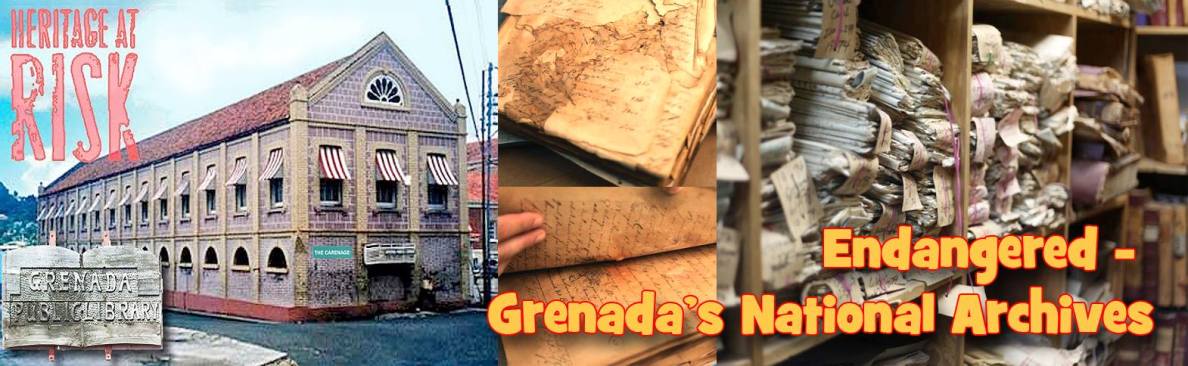
Originally constructed circa 1720, the brick and stone building with fish scale clay tile roof, was first used as a merchant’s office on the first floor and a warehouse at ground level. Up to 1985 the warehouse remained functional, as the metal rails on the ground floor which conveyed the commodities on large metal trolleys across the road, to and from the storeroom (warehouse) to large wooden “lighters,” were still in existence. In the early days the lighters were berthed up to the water’s edge, which took the commodities to and from the waiting cargo ships in the outer harbour, as there was no pier in the inner harbour at that time. The building survived, the great fire of March 1772, those of the Insurrection of 1795, and the many more recent close quarter fires of 1980, 1981, 1990, 2002 and 2005.


Although as far back as 1846 Grenada established a library, it was from about 1950, through the tireless effort of Librarian – the late Sheila Buckmire nee’ St. Bernard, the interior of the first floor of the building was remodelled to house the Public Library, and much later in 1986 the warehouse on the ground floor was included for library and archival purposes, as the need for such services expanded.


Unknown to many, in 1985, the government of the day received funding from the European Union, and the interior of the entire building — (Ground and First floor), was redesigned and repaired together with exterior walls and roof, and became the Grenada Public Library building. However just twenty-seven years on no major maintenance, especially not since hurricane Ivan (in 2004), has been undertaken by the Ministry of Works was undertaken - resulting in the building now designated as “not fit for human occupancy”, and was abandoned in July 2011.


Is It at Risk?


Yes, the building has been on the Heritage at Risk Register since 2004. The building had its roof damaged and the top floor structure with its vault has since suffered from rot and damp. Upper parts of the building houses most of the valuable ancient archived materials and is under great threat of loss from the elements.


The building is far from adequate as a secure archival environment and is always at risk from fire (many have happened over the Carenage's history and from seasonal storms and even hurricanes, as we are far to well aware of.

What’s the Current Situation?


Tragically the building has been vacated and closed since 18 July 2011, a long time since the contents of the building would not have seen the light of day, with the resulting deterioration of the irreplaceable archival material contained therein, and the loss of a large component of our documented history, which does not seem to be of concern to the powers that be.


Grenada is a signatory to the World Heritage Convention, and the Public Library building, along with York House, Government  House and the Market Square — as with so many others of our built heritage and sites, appear to have fallen through the cracks, as the powers that be, appear not to be concerned in upholding the requirements of the convention, to the detriment of our natural and cultural heritage.

18 Oct 2010

Grenada's Endangered Archives

Grenada’s endangered archives programme (EAP295)

Update: Endangered Archives – Digitising Grenada’s Heritage


The British Library’s “Endangered Archives Programme” (EAP) aims to contribute to the preservation of archival material that is in danger of destruction, neglect or physical deterioration world-wide. They achieve this principally through the award of grants in an annual competition. These grants provide funding to enable successful applicants to locate relevant endangered archival collections, to arrange their transfer to a suitable local archival home where possible, to create digital copies of the material and to deposit the copies with local institutions and the British Library.

Thankfully, back in 2009, Grenada was awarded a research grant of £39,297 (about US$60,000 or XCD$162,000) for 21 months by EAP’s International Advisory Panel of academic specialists and archivists: Anthea Case, Nada Itani, Paul Lihoma, Linda Newson, and Branka Prpa (on behalf of the sponsor Arcadia).
A word of caution – this wonderful project has not ‘saved’ the heritage assets of the Grenadian people or its National Archives. Far from it. The EAP has merely conserved, in digital format alone, a small proportion of this heritage. We are grateful for that much but the very documents themselves are still in tremendous danger of being completely lost to all for all time because of the continuing conditions they are under and what is not being done to restore, conserve, preserve and protect them.

Project Overview

Lead by Dr Laurence Brown from the University of Manchester, this project seeks to digitise the unique historical archives of Grenada which record the island’s significance at the intersection of the British and French Empires during the second half of the eighteenth century, and provide a rare vision of how the Windward Islands experienced the transition from slavery to emancipation during the mid-nineteenth century.

The project focuses on attempting to digitising 132 volumes of deed records and local government correspondence which provide a crucial source for understanding the major political, social and economic transformations of the Southern Caribbean. These rare sources can also be used to reconstruct the experiences of the everyday and subaltern lives.

The material vital and rare and provides a micro-vision of how Grenada was transformed in the late eighteenth century by imperial conflicts, the expansion of plantation slavery and revolutionary politics. The Supreme Court records reveal the multi-racial alliances and conflicts that marked slave society while Government House correspondence expresses the local negotiations and conflicts that shaped the prolonged transition to a free society during the mid nineteenth century. The French Records are held in a storeroom of the registry and have suffered considerably from heat, humidity, fading and corrosion. The papers are extremely brittle, the text is beginning to discolour, and the bindings are in danger of damage due to cramped storage conditions.

Government House correspondence was displaced by Hurricane Ivan which resulted in significant loss, and the disruption of its original listing order. The Public Library lost parts of its roof in 2004 which have yet to be fully repaired. Its fragmented newspaper holdings are extremely rare.

The French Deed Records provide a unique vision of the social complexity of Grenadian society as it was being transformed into a plantation colony during the late eighteenth century. They provide a valuable source for tracing the personal trajectories of migrants from Africa, Europe and elsewhere in the Caribbean and for understanding how the social and economic relationships between Grenada’s white, black and large mixed race population were being transformed during this period. The Letter Books of Grenada’s Colonial Secretary offer a detailed narrative of local events which is particularly significant given the limited and fragmented collections of local newspapers held by Grenada’s Public Library and the British Library. These papers provide a revealing counterpoint of local debates to the official correspondence of the Governor held in the National Archives at Kew.

The inter-island correspondence of the Governor in Chief of the Windward Islands during the transition of emancipation is a crucial source for social, political and economic history of the Southern Caribbean, which has remained unused by historians despite the excellent scholarship of Woodville Marshall and Bridget Brereton on the region.

Digitising these records would enable public and scholarly access to these materials not only in Grenada and Britain, but also elsewhere in the Southern Caribbean, where these records would be of considerable interest in St Vincent, St Lucia, Martinique and Trinidad.

The project begins with the newspaper collection of the Grenada Public Library as this allows for a small discrete collection through which project members can be trained in best practice for digitisation and the management of meta-data. During the second third of the project the French Deeds will be digitised while the archival researcher re-orders the Government House correspondence in preparation for later digitisation.

Digital copies of the rare deed records, local government correspendence and local newspapers will be deposited with the National Archives of Grenada and the British Library; the Government House correspondence and Registry records will be ordered and preserved in archival boxes; a digital photographer and archival researcher will be trained in current best practice; and two training sessions on best practice in digitisation and digital records management will be open to relevant professionals within and outside Grenada – it is hoped these would attract public sector personnel from across the Eastern Caribbean.

The project has the full support of the University of the West Indies and the Grenada National Archives, with Dr Curtis Jacobs and Ms Lillian Sylvester project co-applicants from these respective institutions. The Grenada National Archives Committee intends that within the life of this project the Grenadian government will have authorised the construction of a new National Archive building which would be the repository for the originals and digital copies generated by this project.


For the current status check-out our page at Grenada’s Endangered Archives.

Dr Laurence Brown’s Profile

Lawrence Brown (29-02-2012)_smLaurence Brown is Lecturer in Migration History. His main research interests are the Caribbean diaspora (1760-present), labour migration in the remaking of nineteenth century colonialism, and the impact of migration on contemporary Western Europe.
After completing a doctorate in comparative history at the University of York in 1999, he was a lecturer at the University of the West Indies (Barbados) and at the American University of Paris. In 2004-2005 he held a research fellowship at the Centre for Cross-Cultural Research at the Australian National University that focused on exploring the connections between colonial migration networks in the Atlantic, Pacific and Indian Oceans during the nineteenth century.

The Project Begins

In November 2010 James W Robinson, the University of Manchester senior photographer, flew to Grenada to assist and advise on a digitisation project. Before the digitisation project began, we were advised on the right equipment to purchase, and given some basic tips for digitising the archives.
The British Library wrote:
The project seeks to digitise the unique historical archives of Grenada which record the island’s significance at the intersection of the British and French Empires during the second half of the eighteenth century, and provide a rare vision of how the Windward Islands experienced the transition from slavery to emancipation during the mid-nineteenth century.”
James says:
“The digitisation of the Grenada archives is an extremely important project, both to protect the very fragile and ‘endangered’ material, and to open up access to some incredible information and history.
“The project focuses on digitising 132 volumes of deed records and local government correspondence which provide a crucial source for understanding the major political, social and economic transformations of the Southern Caribbean. These rare sources can also be used to reconstruct the experiences of the everyday and subaltern lives.”
Camillo Stewart is Grenada Archive’s project photographer, and Dr. Curtis Jacobs, the project leader. Camillo showed James some of the work that has already been carried out, and the set up which we are using. Currently, the project is using a Nikon D700 to capture the images.

On 15 November James presented to the team, and some invited guests from the Grenadian Government, on the importance of digitisation, and what they do back in the UK. Hopefully, Dr. Jacobs and the team will be able to expand our work, and digitsise a whole host of other material, that is in desperate need of attention.

Laurence Brown joined me, and held a workshop on best practice for digitisation. Hopefully, we will also be teleconferencing with other islands in the area, advising them on similar digitsation bids.

Presentation at the Univeristy of the West Indies

On the 16th James gave his presentation at the University of the West Indies, to the team and invited guests from the public library and government. He says:
“It’s a whole different ball game setting up and working over here. Storage of items is a major issue, there just isn’t the space to move archives into suitable conditions. Luckily, thanks to this project, many positive changes have already taken place, re packaging and organising much of the material.”

Miss Patsy Baptiste, and Miss Roxanne Edwards have been working in the office of the Governor General and the Supreme Court Registry respectively, cleaning, organising and repackaging the material to digitise.


The office of the Governor General holds Government correspondence, letters and records, dating back to the 18th century. The Supreme Court Registry holds many records relating to slavery, criminal records, land deeds, execution records and other historical documents. The space the archives are held is actually the next room along to where the executions used to take place!


We looked at some material in extremely poor condition. These documents are some of the worst affected by hurricane Ivan in 2004. There are some very worrying signs of mould throughout the manuscripts, and some even still feel damp, which means mould spores could still be active. As some of the pages have dried, they have became very brittle, and it is difficult to even turn a page without damaging it. The advice was to leave well alone! Perhaps future funding bids could be applied for which could pay for conservation of these incredibly important items.
Damaged Manuscript
One of the worst damaged manuscripts


On the 17th we took a look at some very fragile documents, and working out the best way to photograph them.

Laurence Brown also presented his paper at the University about migration of the Grenadian people during the 18th and 19th century. It was a very interesting look at some of the social history that has been gleamed from some of the material we have been looking at during my visit.
James ends saying:
It has been a pleasure staying here for the week, I have had such a fantastic trip, and met so many incredible people. Hopefully, other similar projects will get funding all over the Caribbean, and our team will be involved on a much greater level. There is so much valuable material that is in danger of being lost forever.


Remember to check out the latest by joining our Facebook Group at Grenada’s Endangered Archives
« Prev Page | Next Page »