Grenada National Archives - Protection, conservation, access
The threat to archives -
“Documentary heritage reflects the diversity of languages, peoples and cultures. It is the mirror of the world and its memory. But this memory is fragile. Every day, irreplaceable parts of this memory disappear for ever.”
UNESCO Memory of the World Programme.
Ric Greaves on histories in peril
Sadly very little protection or conservation has been undertaken by Grenada and reconstructing this important and endangered archive relies heavily on a 1968 document produce by E. C. Baker’s called A Guide to Records in the Windward Islands. Thankfully the Endangered Archived Project number 295, undertaken by the British Library (with the financial support of Arcadia) has now managed to give us ‘access’ to at least some 4500 digital images from our existing archives.
Back in 2009 the British Library (with the financial support of Arcadia) began an US$64,000 project to protect and disseminate historical records of pre-industrial societies such as our own.
This British Libraries EAP was part of the US$18.0 million awards of some 41 research grants for records throughout the world, including the Caribbean, which are fast disappearing through neglect, physical deterioration or destruction - the Endangered Archives Programme is aimed at safeguarding some of this documentary heritage world-wide. The entire programme now has over one million images available online! They have new online collections every month which has taken the total number of images available in our collections over this one million mark. These collections come from India (EAP201), Lesotho in Southern Africa (EAP279), Mongolia (EAP529) and finally our own Grenada (EAP295).
Although 132 volumes of deed records and local government correspondence were identified in Grenada, the EAP295 Project had to remain modest in conception and rooted in practicality – it was not aimed at promoting theoretical advances in archival management or cutting-edge technology in digital preservation – it was about quick achieving result on the ground.
Project EAP295 began with two weeks of digital photography under a team from the University of Manchester led by Dr Laurence Brown and photographer James W Robinson which took place in November 2010. This was only a part of the unique historical archives of our island, material which provides a micro-vision of how Grenada was transformed in the late eighteenth century by imperial conflicts, the expansion of plantation slavery and revolutionary politics.
The two main sources of records are from Government House and the Supreme Court. The Supreme Court records reveal the multi-racial alliances and conflicts that marked slave society while the Government House correspondence shows the local negotiations and conflicts that shaped the prolonged transition to a free society during the mid-nineteenth century.
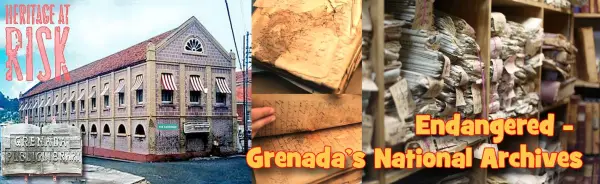
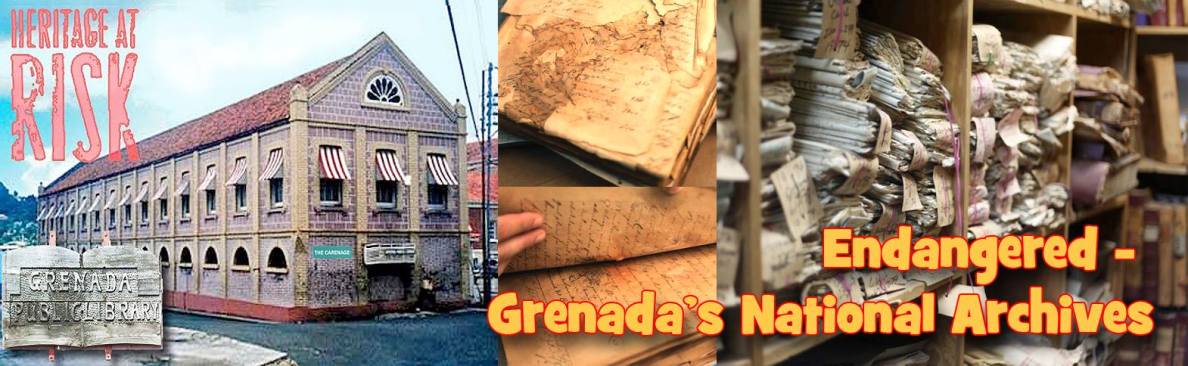
During Hurricane Ivan in 2004 the Grenada Public library (our National Archives) lost part of its roof and the Government House correspondence became displaced and out of order. There was no item-level index of this material so series P material needed to be ordered chronologically then digitisation focused primarily on those works which were seen as the most fragile due to their age or unbound condition. This greatly hampered the project which needed to have material chronologically reordered before digitising could take place.
The project focused on digitising just twelve volumes and files of Governor and Lieutenant-Governor’s correspondence covering the period 1764-1879 and the Letter Books of the Administrator and Colonial Secretary (series P) because these were far more fragmented than the Governor’s correspondence.
The material at the Supreme Court Registry was far better preserved than at Government House as it was relatively unaffected by Hurricane Ivan. Loose-leaf documents previously identified as connected to the eighteenth century French Deeds formed the initial focus of in situ digitisation in the Supreme Court Registry. Many of the bound volumes of French Deeds identified by the project required such extensive preservation and conservation work that their digitisation would have destroyed their physical structure. By stabilising their storage and digitising those materials in the Supreme Court Registry which were already fragmentary or fragile, the project was able to make a significant step towards its original aims.
Digitisation also continued in the Supreme Court Registry on the Births, Deaths and Marriages Registers for St Georges and records related to Forfeited Estates, 1794-1802. During this time one of the Archival researchers employed by the project cleaned, sorted and ordered the French Deed bound volumes and unbound materials.
The material at the Supreme Court Registry was far better preserved than at Government House as it was relatively unaffected by Hurricane Ivan in September of 2004. Loose-leaf documents previously identified as connected to the eighteenth century French Deeds formed the initial focus of in situ digitisation in the Supreme Court Registry. Digitisation also covered some of the Births, Deaths and Marriages Registers.

A total of 4589 pages were finally digitised, indexed, catalogued and a full list of digitised documents now available online are:
EAP295/1
"Holding of Government House are listed in Baker (1968), pp. 14-18. After Hurricane Ivan, around half this material has survived, with particularly heavy loses of documents from the late 1800s and first half of the twentieth century. Digitisation focused on the earliest surviving records of Government House”.
- Governor correspondence [1764 - 1768] (198 pages)
- Lieutenant Governor correspondence [1829 - 1833] (200 pages)
- Lieutenant Governor correspondence [1833 - 1840] (378 pages)
- Lieutenant Governor correspondence [1846 - 1850] (329 pages)
- Lieutenant Governor correspondence [1850] (16 pages)
- Lieutenant Governor correspondence [1853-1855] (455 pages)
- Lieutenant Governor correspondence [1854 - 1856] (487 pages)
- Lieutenant Governor correspondence [1856 - 1862] (573 pages)
- Lieutenant Governor correspondence [1859 - 1869] (358 pages)
- Lieutenant Governor correspondence [1862 - 1865] (321 pages)
- Despatches to Lieutenant Governor Barbados [1873 - 1877] (458 pages)
EAP295/1/2
"Holding of Government House are listed in Baker (1968), pp. 14-18. After Hurricane Ivan, around half this material has survived, with particularly heavy loses of documents from the late 1800s and first half of the twentieth century. Digitisation focused on the earliest surviving records of Government House”.
- Proclamation of customs duties by George III [July 1764] (1 pages)
- Proclamations by Governor Ninian Home [January 1793 - January 1795] "Proclamations by Governor Ninian Home on importation of goods in British vessels, disarming immigrants in the island, declaration of martial law" (6 pages)
- Proclamation by Governor Kenneth Mackenzie [June 1795] Proclamation by Governor Kenneth Mackenzie on registration of foreigners (2 pages)
- Legal papers [December 1844 - April 1851] "Correspondence by J Riddel on extradition agreement between colony of Grenada and Venezuela, the death penalty in Grenada and on eligibilities of town councillors" (22 pages)
- Inquiry into the state of the Colony Hospital of Grenada [October March 1850] - Inquiry into the state of the Colony Hospital of Grenada (35 pages)
- Correspondence on discontinuing the Government House guard [April 1850] Correspondence on discontinuing the Government House guard (4 pages)
- A Bill to further ammend the Law as to the distribution of the pews in the parish church of St George [October 1858] (8 pages)
- Reports on indentured immigration to Grenada [July 1867] Report on the sanitary condition and the mortality of Indian Immigrants and a return showing the location of the Indian Immigrants in the Island of Grenada (3 pages)
- Proclamation by Colonial Secretary Leslie Probyn on celebration of Diamond Jubilee of Queen Victoria [June 1897] (1 pages)
- An Agreement between Montagu Frederick Ommanney and Ernest Edward Blake with the General Concessions Syndicate Limited [1890s] (12 pages)
EAP295/2
The earliest family records held by the Grenada Supreme Court Registry is for the French period 1762-1785.
- St George Register of Baptisms, marriages and burials [1765] (101 pages)
- St George Register of Baptisms, marriages and burials [1765 - 1785] (83 pages)
- Gouyave Register of Baptisms, marriages and burials [1779 - 1782] (46 pages)
- Gouyave Register of Baptisms of Slaves [1780 - 1782] (29 pages)
- St Jacques (now St George) Register of Baptisms, marriages and burials [1782] (42 pages)
- St Jacques (now St George) Register of Baptisms, marriages and burials Vol 2 [1782] (46 pages)
- French Marriage Register [1765] (20 pages)
- Sales of forfeited slaves [1797] (24 pages)
- Commissioners of Forfeited Estates Letter Book [1797 - 1802] (42 pages)
- Commissioners of Forfeited Estates claims allowed and paid [1794 - 1796] (38 pages)
- Court of Oyer and Terminer for Trial of Attained Traitors record book [1796] (82 pages)
A pdf transcription for this record book can be found at: http://eap.bl.uk/downloads/eap295_2_6_1_transcription.pdf
Unbound French legal document.
These boxes of unbound French legal documents was reconstituted by Dr Curtis Jacobs (UWI Grenada)
- Unbound French Documents, Box 4 [1779 - 1780] (35 pages)
- Unbound French Documents, Box 5 [1783] (52 pages)
- Unbound French Documents, Box 13 [1780 - 1785] (78 pages)
Note: Arcadia is a grant-making fund established in 2001. Lisbet Rausing and Peter Baldwin form the Donor Board. Peter Baldwin is Chair of the Donor Board. The fund was formerly the Lisbet Rausing Charitable Fund. As of September 2013 Arcadia had awarded grants of more than $243 million.