14 Jan 2014

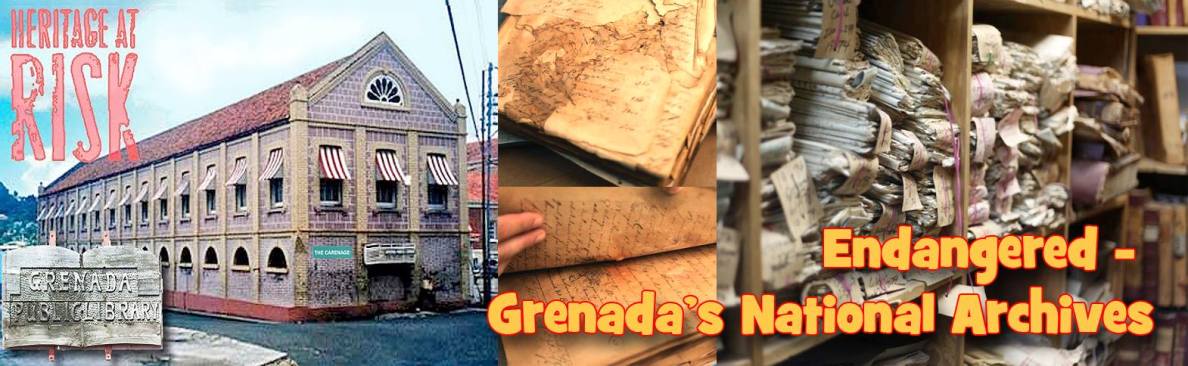
Grenada's Endangered Archives
The newyear begins and we hear that Pranical Technologies and UNESCO, through the Communication & Information Sector, informs us that the IFAP plans to protect historical documentary resources on Grenada.

Archives damaged by the effects of termites,
Grenada National Library, St. Georges

The Intergovernmental Information for All Programme (IFAP) has recently launched an information preservation project in Grenada, which is helping to protect valuable and rare historical documentary resources. The project is also providing useful experiences that can inform actions in other Small Island Developing States (SIDS). It is one of several initiatives undertaken in the Caribbean during the 2012-2013 biennium with the financial support of UNESCO’s Multi-donor Emergency Fund.

According to Jasmin Garroway, from the National Commission in Anguilla (UNESCO’s newest Associate Member),
the project undertaken in Grenada provides important technical insights that are an inspiration for the members of the National Memory of the World Committee, which is being established“.

Insights into the complex political, social and economic changes that have transformed Grenada over the past 300 years can be found in its national archives. But today, this archival heritage, which managed to survive the military exploits during the colonization of the new World and the more recent Cold-war era, is now threatened by inadequate storage and natural causes.

Hurricane Ivan, which hit the island in 2004, compromised the main library and the national archives. As a result, these collections were dispersed to makeshift emergency storage areas. The limited resources available to the Government, the need to respond to other more urgent human needs, as well as the inadequacy of what was only intended to be temporary storage has seen these precious resources become endangered.

Recently, the Government launched a ‘major effort‘ (sic) aimed at obtaining finances to restore the public library and protect its archives, but even as these plans are being put in place, the ravages of humidity and termites continue their assault on the fragile materials.

Discussions between the IFAP Secretariat and the official Delegation of Grenada during UNESCO’s 37th General Conference helped to identify some immediate interventions that could forestall this degradation. A project was conceived to train government staff and local volunteers in inventorying the archives, relocating them into more favourable locations, protecting them from termites and humidity as well as acquiring equipment to support the digitization of the archives.

N.B. None of the aforementioned consultants of the delegation have been named and ‘training governmental staff and volunteers‘ is a feeble response to the urgency of our plight, and we fear who these ‘information professionals‘ are – still this small response is better than the previous decade of no response.

Joan-Marie Coutain, Secretary-General of the Grenada National Commission, says,
Within the space of a few weeks, our discussions with UNESCO were transformed into a proposal that was then concretely implemented on the ground. We now have young trained Grenadian volunteers working under the guidance of government information professionals and using the equipment acquired for this project to save our documentary treasures.

The intergovernmental Information for All Programme was established in 2001. It provides a platform for international policy discussions, cooperation and the development of guidelines for action in the area of access to information and knowledge. The Programme also supports Member States to develop and implement national information policy and strategy frameworks.

James Gill's photo.


Remember to check out the latest by joining our Facebook Group at Grenada’s Endangered Archives
« Prev Page | Next Page »

10 Jan 2014


In our continuing series on capturing Grenadian heritage we look at – David Hedog-Jones.
By Ric Greaves 18 Oct 2013

David Hedog-Jones (c1875-1942)

Grenadian School Headmaster; WWI Captain; African School Headmaster; and Vicar.


Margaret Edith (née Martin) with her new husband David Hedog-Jones,
Captain in the British West Indian Regiment, on their wedding day 29th of July 1916.

David Hedog-Jones was probably born not far from Hedog in Gwynedd North Wales, close to Aberdaron, sometime in the 1870's, however his birth and marriage details have currently not been found.

Unfortunately we know almost nothing of his early life and indead exactly how how he came to be in Grenada.

We do know that in 1910 he earned his National Diplomas (B.A., B.Sc.) in Dairying from the University College of Wales (Aberystwyth) and the British Dairy Institute, Reading and must of took up the post of Headmaster a Grenada Boy's Secondary School (GBSS) in Grenada immediately.

The GBSS was founded as a fee-paying school back in 1885 by the Cocoa and Sugar planters of the island for their children and followed the English grammar school style of education.  However, the Colonies were looking to develop education throughout the empire and at about this time the school was reorganized and reopened at the renovated premises on Melville Street, Saint George's as a free government school with between seventy and eighty boys on the 18th of September 1911.

In 1912 David, as Headmaster of GBSS, published his paper on "Agricultural Education in Grenada".  It illustrated the difficulty he and Grenadian schools in general had with the development of vital education in the field of agriculture.  The paper dealt with the importance of agricultural education on the island in its various aspects as consideration on the part of authorities in the West Indies, during the previous decade, particularly the work of the Imperial Department of Agriculture.  At the time attempts had been made to introduce rural teaching into Grenada elementary schools, the main purpose of the paper was to show how the re-constituted secondary school in that island would be made to bear relationship to the island in general and to the agricultural community in particular.  It seams, however, that he failed in attempts to introduce nature study as a useful subject, into Grenada elementary schools.  The lack of requisite and sympathetic knowledge on the part of teachers in the schools — a condition due specifically to the fact that lectures given to such teachers in the in the earlier years were not followed up by further courses.  The enthusiasm first engendered soon waned, and a few years later it was proposed that grants should be curtailed in the case of schools that did not use their agricultural plots.  The matter began to be serious toward 1907, and since that time the agricultural plot were finally literally abandoned.


This was followed by his attendance to the eighth West Indian Agricultural Conference held in Jamaica in January that year and prompted his 71 page paper entitled the same.

Meanwhile his experiences in Grenada promoted his drive to understand the origin, the behavior, and the physical, social, and cultural development of the islands people - leading his to attain another M.A. from Jesus College at the University of Oxford in 1914.  This led to his next two books "Glimpses of the Caribbees and Elsewhere" and "West Indian Studies" which look into folk lore, religion, magic, agricultural conference, and glimpses of the Caribees.


Unfortunately on the 28th of July of that year, just one month after the Austrian Archduke Ferdinand and his wife are assassinated by the student Gavrilo Princip, the world was thrown into the horrors of our First World War and the estimated casualties of 37 million men which included 8.5 million deaths.  A dark cloud is looming over everyone in the British Colonies and would soon reach the Caribbean and Grenada...

In April of 1915 David encourages the GBSS to published a school magazine, "The Caribbean" which outlines the progressive work school and he himself submits an article on agricultural education in Grenada emphasizing the necessity of bringing the teaching of the primary schools into a more direct connexion with that of the secondary school.  The following year the magazine contained an interesting collection of folklore and brings out the striking characteristic of West African folklore, namely, the strong personification of animals, particularly the spider and also a list of West Indian proverbs.


David had met Margaret Edith (born in 1876 in Sunderland, Durham, England), she was the daughter of Canon Henry Martin.  It wasn't too long before the couple had a son, David Henry James who went on also to have gain an M.A., have a military career as Flight Lieutenant in the Royal Air Force, receive an M.B.E, and become a Councillor in 1966 and Mayor of Cheltenham (England) by 1974.

Lt. David D. H. J. Martin-Jones


With the war looming many young couples felt a more urgent need to make their commitment to each other more permanent and likewise David married Edith on the 29th of July 1916. 

However with the heavy rains of October 1916, the looming war began calling more of it's children to fight and David had to leave the GBSS and join up.  His departure was noted as follows:-
"Owing to the departure of Mr. Hedog-Jones, science teaching at the Grenada Boys' School is in abeyance. This has caused delay in the beginning of work under the new agricultural cadetship scheme".


On the 29th of November 1916 Captain David Hedog-Jones of the Grenada Volunteer Force takes up his position as Temporary Lieutenant of the Fifth Battalion of the British West Indian Regiment.

By the May of the following year he is made Temporary Captain in the Oversea Contingent of the BWIR.  Like all staff officers he was in the classification FF which denoted gradings for War Office posts for pay and allowances of up to £400 per annum.

Finally by in August of 1919 Captain C. H. Burke relinquished his rank, David was obliged to take up the position of Temporary Major.

During the end of 1917 their second child, daughter Edith is born in Great Ouseburn, Yorkshire (England).

We haven't, as yet, found the records of his war career but we do know that when in February of 1920 David was in Haifa, Palestine on the staff of the Department of Agriculture at a time when the first of two large political demonstrations took place proceeding the events of Easter weekend David was very much there and wrote:-
"...in the absence of both police and soldiers, the breaking open of shops in the New Bazaar, and looting was absolutely unrestrained".
The war over, officially David relinquished his rank of Temporary Major two years later in October of 1920.  At about this time he became a member of the Palestine Oriental Society and Society of Cymmrodorion.

As with many soldiers of that period it is evident that the war had a profound effect on David.  Most certainly with the influence and support of Margaret Edith he turned to religion and became a Vicar and in 1923 the family are living at the Kelloe Vicarage in Coxhoe, Durham (England).

At some point in 1923 David was invited by Hugh Clifford to take up a post as the Organiser of Practical Education to control the Trade Schools in Accra on the Gold Coast and he and Margaret travelled by ship to Ghana, Africa.  He was there to aid with the development of education in Accra as Headmaster and member of the ‘European’ (as apposed to African) staff of the four JUNIOR TRADE SCHOOLS, which consisted of three other headmasters Lieut.-Col. E. St. J. Christophers (deceased by 14 Feb 1924), D.S.O., Captain H. G. Ardron, Captain A. Drake. Brockman, and one relief headmaster). The African staff were four each of Woodwork, Metalwork, Masonry, Agricultural and Literary instructors.

Although he took five months leave in the second half of that first year he spent the whole of the next two years there teaching and developing the schools.  He wrote a short report on the four Junior Trade Schools on the 17 Aug 1925.  They were all, at the time, in temporary buildings one for the Eastern Province (Kibi with 72 pupils), the Central and Western Provinces (Assuantsi, 60 pupils),Northern Territories (Yendi, 90 pupils), and one for the Ashanti (Mampong, 60 pupils.  This later school was originally ministered by Elizabeth W Telfer as headmistress in charge of the Province until, April 12th when she left and David then took charge, and he was required to combine the duties of Acting Provincial Inspector of Schools and Headmaster of the Junior Trade School, Mampong. until she returned on October 1st.

Rev. David and Margaret Edith returned to England some time before 1929 when the family moved to the Brookthorpe Vicarage, near Gloucester (England) where they remain for some ten years.  Then in March of 1932 he was the Incumbent of the Benefice of Brookthorpe with Whaddon where he was on the Toddington Parish Council with Margaret Edith.


The former educator of the Grenada Boy's Secondary School passed away whilst at home in
Ewesham Road, Toddington near Cheltenham (England) on Tuesday 24th of March 1942.

Ten years later David's son married a member of the Grimsby family of Lincolnshire (England) and county tennis player, Miss Susan Anningston Tickler, daughter of the late Mr Harry Tickler, at St James' Church on the 7th of July 1952.  And Margaret Edith lives almost another two decade and died as a widow aged 84 on the 24th of November 1960 in the family home.


References

  • D. Hedog-Jones, “Agricultural Education in Grenada, with Special Reference to the Secondary School for Boys”, West Indian Bulletin, vol. 12-13, 1912, p.221
  • D. Hedog-Jones, "A West Indian Agricultural Conference", 1912, pp.71
  • D. Hedog-Jones, "Glimpses of the Caribbees and Elsewhere", 1914, pp.97
  • The Agricultural News, vol. 14, no. 338, 1915, p.124
  • The Agricultural News, vol. 15, no. 358, 1916, p.44
  • D. Hedog-Jones, "West Indian Studies", 1916, pp.97
  • Ed., D. Hedog-Jones, "The Caribbean", vol. 1, 8vo., 1916
  • The London Gazette, Issues 30295 to 32127
  • Palin report, British National Archives (FO 371/5121)
  • Gloucestershire Echo, 1942, p.4
  • Cheltenham Chronicle, 1942, p.6
  • C. L. Joseph, “The British West Indies Regiment 1914–1918″, Journal of Caribbean History, vol. II, May 1971, pp. 94–124

1 Jan 2014

The British West Indies Regiment

IWM
Three lads of the British West Indies Regiment
The regular West India Regiment long pre-dated the “Great War” and its 1st Battalion, based at Freetown, sent a detachment for service in German Cameroons. 2nd Battalion saw much service in the West and East African campaigns and then went to Palestine in September 1918.

The so called “Great War” or World War I, covering the four years of 1914 to 1918, began in central Europe in late July 1914, and though it’s causes included many churlish factors – such as the conflicts and hostility between the larger European powers of the four decades leading up to the war – militarism, alliances, imperialism, and nationalism played major roles in the conflict that ended in throwing away the lives of millions of young men – not for what the bileived to be true and good but for a select few who beleived their power was under threat. The immediate origins of the war, therefore, lay in the decisions taken by statesmen and generals during the “July Crisis” of 1914 caused by the assassination of an Archduke, Franz Ferdinand, and his wife Sophie by the Surbian student Gavrilo Princip, an irredentist member of a Serbian nationalist organization called Black Hand.
Following the outbreak of these hostilities in 1914 many West Indians left the colonies to enlist in the army in the UK and were recruited into British regiments. However, the War Office was concerned with the number of black soldiers in the army and tried to prevent any people from the West Indies enlisting. Indeed, the War Office threatened to repatriate any who arrived. Eventually, after much discussion between the Colonial Office and the War Office, and the intervention of King George V, approval to raise a West Indian contingent was given on 19 May 1915. On 26 October 1915 the British West Indies Regiment was established.
The creation of the British West Indies Regiment, passed on 3 November 1915, was formalised by Army Order number 4 of 1916. The Order stated that the regiment would be recognised as a corps for the purposes of the Army Act.

Battalions formed by this regiment

1st Battalion
Formed at Seaford, Sussex, England from West Indies volunteers: A Company from British Guiana, B from Trinidad, C from Trinidad & St. Vincent, D from Grenada & Barbados.
Served in Egypt and Palestine.
War diary September 1915 – April 1919 (WO95/4427, 4433, 4410, 4732)
2nd Battalion
Served in Egypt and Palestine.
War diary January 1916 – April 1919 (WO95/4427, 4433, 4732)
3rd Battalion
Served in France & Flanders.
War diary March 1916 – January 1919 (WO95/4465, 338)
4th Battalion
Served in France & Flanders.
War diary May – November 1918 (WO95/409)
5th Battalion
A reserve draft-finding unit .
War diary July 1916 – April 1919 (WO95/4465)
6th Battalion
Served in France & Flanders.
War diary March 1917 – April 1919 (WO95/495)
7th Battalion
Served in France & Flanders.
War diary June – December 1917 (WO95/409)
8th Battalion
Served in France & Flanders and went to Italy in 1918.
War diary July – December 1917 (WO95/338)
9th Battalion
Served in France & Flanders and went to Italy in 1918.
War diary July – December 1917 (WO95/338)
10th Battalion
Served in France and Italy.
11th Battalion
Served in France and Italy.

Pic
The regimental badge as depicted by CWGC on the gravestone of Pte 13576 Phillip Byles of the 10th Battalion. He now lies in Longuenesse Souvenir Cemetery near St Omer in France. Author’s collection.

The contribution of the West Indies

A total of 397 officers and 15,204 men, representing all Caribbean colonies, served in the BWIR. Of the total, 10,280 (66%) came from Jamaica. Athough at least 380 men served in this war from Grenada, they had joined many regiments all over the globe (primarily throughout the USA).
In addition contributing to the British West Indies regiment, Bermuda raised two more contingents: the Bermuda Volunteer Rifle Corps (which was attached to the 1st Lincolnshire Regiment) and the Bermuda Garrison Artillery. Other men joined other British and Canadian regiments; some quite possibly joined the United States army too but we have yet to confirm this.

Further reading

  • F. Cundall, Jamaica’s Part in the Great War, 1914–1918 (Institute of Jamaica, 1925)
  • Guy Grannum, Tracing Your West Indian Ancestors (PRO Publications, 2002)
  • C. L. Joseph, “The British West Indies Regiment 1914–1918″, Journal of Caribbean History, vol. II, May 1971, pp. 94–124
  • Richard Smith, Jamaican Volunteers in the First World War (Manchester University Press, 2004)
  • J. A. P. M. Andrade, A Record of the Jews in Jamaica: From the English Conquest to the Present Time (Jamaica, 1941). This includes a list of the Jewish members of the Forces who were from Jamaica, who served during the First World War (not all of whom served with the BWIR).
  • The list of the first 380 Grenadian men aged 14 to 40 who left for the US, UK, Canada and Austrailia shortly before WW1 and then joined up, G.N.A, 1920, pp.4.