13 Jun 2011

Archive Talk - Birth dates and the British Empire


I always feel a mild sense of archivist euphoria when I encounter a document bearing my birth date: 9 July. Certainly the oldest such document I’ve uncovered while working on the ARCHIVE project lives at the Rosenbach Museum and Library: a 9 July, 1657 letter written to John Thurloe, British secretary of state under Oliver Cromwell, from one of his officials on the island of Jamaica. “Imagine,” I thought, staring at the letter, “this was written 330 years to the date before I was born!”


Then, when I read a bit of the letter and discovered it was a sobering missive relating early British colonizers’ attempts to “subdue” the island’s indigenous population. The letter-writer—apparently a British soldier named William Brayne—requests that Thurloe dispatch to the island “bloodhounds” to assist soldiers in “finding and killing” Jamaica’s “wild negroes.” The letter continues:

“I am Confident [that] if his Highness did but know how useful they [the bloodhounds] might be here he would cause some to be speedily sent” (Volume 3, p. 121).


Rosenbach - Thurloe


The topic of the letter, though cold and detached, even clinical in the way in which Brayne discusses the topic made me appreciate how the Caribbean islands have grown and developed through a hard history even more. It’s not every day that you read a coolly written letter requesting the tools by which to police (some would say subjugate) an unstable civilization.


Perhaps I shouldn’t have been too surprised, given the years covered by the John Thurloe papers—1655 to 1660. By this time, the British Empire had established its dominion: in parts of the present-day United States, in many of the smaller Caribbean islands, and in Asia, Africa, and other regions. It had also, by this time, established and consolidated a number of trading companies, like the British East India Company, to administer the colonies and capitalize upon their economic possibilities. Furthermore, the Empire had just signed the Treaty of Westminster, ending the first conflicts in the Anglo-Dutch Wars, and was well-embroiled in the Anglo-Spanish War (1654-1660), which was sparked by commercial rivalry and resulted in the English takeover of Jamaica in 1655.


As an aside, more of a note of fact, the "wild negroes" referred to were a people traveling the smaller islands, stretching from St. Thomas to Tobago, a warlike and indomitable race, collectively known as "Charaibes" or "Caribs," who resisted every attempt at colonization on the part of Europeans, and preferred death to the withering slavery that became the fate of the natives of the larger islands. So stubborn was the resistance offered by these dauntless people that settlements in the places held by them were not effected until long after the other islands begun their flourishing plantation and civilized communities.  The group should not be confused with the race of people, who at this same period, lived Cuba, San Domingo, Jamaica, and the other larger islands in the West Indies, they were a mild and timid race, generally called Arouagues by Labat, Du Tetre and other French historians of the 17th century.


By the time the Protectorate collapsed and Thurloe lost his job in 1660, paving the way for the return of the monarchy and the further expansion of the British Empire, the “wild negroes” of Jamaica had been sold into slavery, exploited by British trade groups as free labor for the burgeoning sugar cane and coffee industries. (Enslaved Africans were also transported to the island.) A century later, the Jamaican slaves—who by then well outnumbered their white masters—mounted Tacky’s Revolt, an attempt to overthrown the colonial government. Untypically of many Caribbean islands, Jamaica have more than two centuries of violence and political upheaval.  However, with the changing politics of the Sugar world Jamaica, as with most Caribbean islands, could finally become independent and they achieved this on 6 August, 1962—a mere twenty-five years before my birth, in 1987.


The Thurloe papers at Rosenbach are chock-a-block full of interesting insights into Protectorate-era England (at least for those who can decipher seventeenth-century script).

28 May 2011

Save Melrose House


Melrose House - Source: The Willie Redhead Foundation


In August of 2010, many Grenadians became aware of the potential to lose yet another of Grenada’s significant historic heritage sites. In this case, the threat was not from a natural disaster like hurricane Ivan, but from the wrecking ball. Threatened is Melrose House of Gouyave, in St. Johns Parish.


Melrose House, believed to be built in the early to mid-19th century, is threatened by its new owners who would like it demolished in order to make way for construction of a new hardware store on the site where it currently stands.


The building, believed to be first owned by the Commissiong family, is one of few of its type remaining in Gouyave today.


Melrose House, is a good example of Caribbean Architecture from the mid-19th century.


It encompassed the combination of French and English elements that defines architecture that is uniquely Caribbean.


One looking to identify the different architectural styles utilized in the design of Melrose House can find French in the steep pitch roof, English in the double-hung windows, and in it raised basement.


The placement of buildings on piers, which help improve ventilation and protects against floods, and the implementation of deep porches that provide shade and shelter for inhabitants and buildings alike, are ideas European builders learned from the building methods.


This point is important, because to a large degree, many in Caribbean populations reject the historic architecture found throughout the Caribbean, on the grounds that they are a vestige of colonial times and lack connection to them. Grenadians are likely no different.


Not only is a landmark like Melrose House representative of the cultural amalgam that defines Grenadian society, but it is part of the historical continuum that connects Grenada’s past and present.


The cavernous underside of Melrose House, where large rum vats were stored, and the existence of Grenada’s longest-ever-built wooden jetty nearby, suggests a connection to Grenada’s industrial heritage past, in which large shipments of rum were exported to Europe.


Between 1930 and 1940, Melrose House transitioned from private to public ownership , and for a period was the residence of successive Attorneys General of the Windward Islands.


Notable among those that resided at Melrose house was Justice Keith Alleyne, the renowned Queens Council, Attorney General of the Windward Islands, and acting Judge of the Windward and Leeward Islands High Court. Sir Louis Cools-Lartigue, who was Chief Secretary of Windward Islands and serve as interim President of Dominica, also resided at Melrose House.


Because Melrose House served as the residence of the Attorneys General of The Windward Islands, the history of the OECS, which succeeded the West Indies Associated States, is replete with the names of persons who at some point stayed there.  The demolition of Melrose House would represent the ripping out of a page in Grenada’s history book.


Declaring Melrose House a national heritage landmark and developing it as a small museum is one way to preserve and protect it from destruction.  This museum can follow the numerous examples of small museums worldwide, whose mission is the preservation of heritage and cultural properties of significance, in order to exhibit they role in the development of societies. Some notable examples of this regionally and globally are: Arlington House, Speightstown, Barbados; Greenwood Great House, Montego Bay, Jamaica; Goethe House in Frankfurt, Germany, and Thomas Jefferson’s Monticello, Virginia, US.


Creating The Melrose House Museum would have a direct impact on the town of Gouyave. Combined with a well define historic district, Gouyave would benefit in a variety of ways – most notably through economic activity from increased daily tourist visits and raising the profile of the town as a destination in Grenada.


Melrose House can be the foundation for a national museum system, whose mandate would be the management and preservation of significant heritage buildings and sites throughout all of Grenada.


An INTERCOM 2006 Conference Paper, titled Measuring the Impact of Museums on their Communities: The role of the 21st century museum notes that:


… the value of local museums were the links back to community; opportunities for people to visit, including attending events; the work opportunities (both paid & unpaid) that were available; the wealth that the museum creates in the local community leading to generate money to go back to the community. Broader outcomes were also identified, such as developing an appreciation of place and culture, community pride, museums preserving heritage, and opportunities for learning across all age levels.


Structures like Melrose House (and there are many throughout Grenada) provide an invaluable service, bridging the Grenada of now to that of yesteryear. Through they existence, Grenadians and visitors alike are provided tangible connections to the country’s rich history and heritage.


If the living Grenadian history that Melrose House embodies is allowed to die; if the profits of one business man trumps the interest of an entire nation and it generations to follow, then Grenada must answer some fundamental questions about what it is as a society.  Is Grenada a place that can strike a balance between short term economic gain and long term cultural preservation?  Is Grenada a country with leadership that can devise innovative approaches that enables it to leverage its historic character for both cultural and economic purposes?  And lastly, but probably most important: Are Grenadians willing to fight for the history that so much defines them?


What happens to Melrose House will provide an answer that will reverberate for generations to come.


The Grenada Action Forum will like to acknowledge the contributions of Mr. Ray Smith towards this article and is lifelong dedication to the preservation of Grenada’s heritage and historic places and sites.

28 Mar 2011


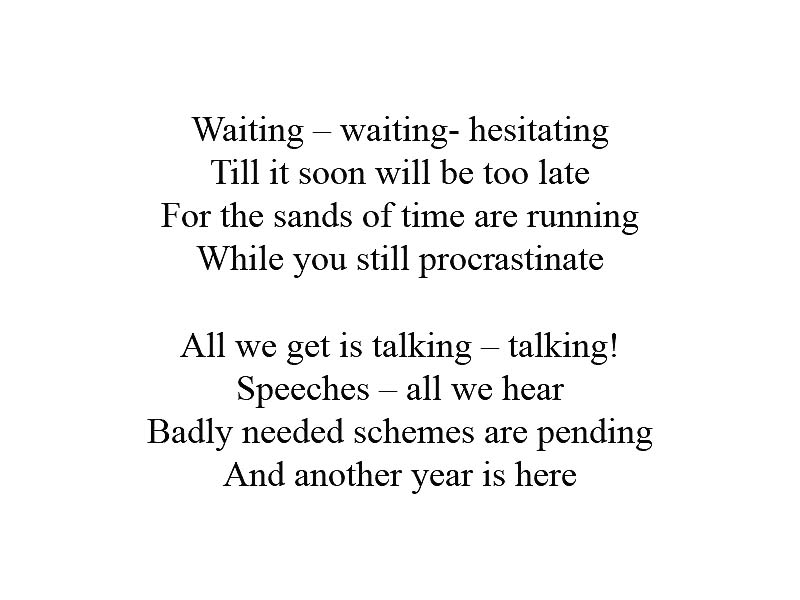
From “Poems of Life” by Dr. Leonard Merrydale Comissiong (c.1940).


The poem above was written more than seven decades ago, and according to The Sentinel’s view is not very different from our GRENADA TODAY.


After listening to Mr. Simon Stiell – the recently appointed Director of the Board of Tourism, on the George Grant Sunday programme of 20th March 2011, one gets the feeling of déjà vu, we have heard it all before; but in fairness to Mr. Stiell we should give him the benefit of the doubt in his proposed strategic and pragmatic programme which the Board of Tourism is planning to undertake in the near future in order to remain competitive in the global arena.


Before going further, the Sentinel would like to congratulate the “Sunday with George Grant” programme in bringing important current national issues to the fore in an effect to educate and inform the Grenadian public. In this particular Sunday programme the public was very vocal in reminding Mr. Stiell of the “Jewel in the Crown”, both of which have been given lip service in the past.


The Crown is of course the tropical paradise of Grenada, and the jewel is its capital city of St. George. As the public by now is generally aware, the Willie Redhead Foundation from its establishment in 1994 has been an active participant in the rescue mission to save our capital city and our natural and cultural heritage in general.


Fort George


Fort George


“The city of St. George is recognized regionally, and perhaps internationally … The Organisation of American States as early as 1988 designated the city as “a monument of the wider Caribbean”.


Our original mantra in 1994 was “the Willie Redhead Foundation for the preservation and urban renewal of St. George’s”, which was later changed to “the Willie Redhead Foundation for the preservation and renewal of the National Heritage of Grenada”. Over the past sixteen years we have endeavoured to fulfill this mandate in several ways, the most important of which is / was to engage both the past and current administrations of the need to save the “jewel”, but with little or no positive response.


The city of St. George is recognized regionally, and perhaps internationally, as the Georgian Society of the United Kingdom over half a century ago gave it special mention as a unique Georgian town in the Caribbean. After the passing of Hurricane Ivan, in their assessment of the damaged caused, both the World Bank and the Caribbean Development Bank recommended to the then Government that the buildings in the city of St. George should be


Anglican Church - post Ivan


urgently repaired and or restored as the case may be as the historic city (the jewel) is of tremendous value in the economic recovery of Grenada and as a tourism product in particular. The Organisation of American States as early as 1988 designated the city as “a monument of the wider Caribbean”.


But when we examine what has taken place in the town since 1988 we see a city of neglect and perhaps gross abandonment as the Authority responsible for the protection of our built heritage appear not to have an understanding of the value of heritage in nation building and national identity and has become in fact, a part of the problem, when we observe the Regulatory Authority contravening its own regulations when granting building approvals especially in the case of existing heritage buildings.


… the historic city (the jewel) is of tremendous value in the economic recovery of Grenada and as a tourism product in particular.


Tibeau Graves, Carriacou


Unchecked erosion of Tibeau cemetery


In order to comprehend its wanton neglect lets take a look at Fort George with its enormous tourism potential, which has been alluded to by The Willie Redhead Foundation (tWRF) on several occasions in the past, and recently by a product of ST. John, now a United Kingdom Professor in the field of Education namely – Prof. Gus John in his memo to Government Ministers, the Market Square is now a shanty town, together with the buildings around the square, the depressing state of York House and the Governor General’s residence, Edinburgh House at the top of Young Street, the old St. James Hotel-not so long ago the home of the CID, the burnt-out L.A. Purcell store on Halifax Street, Rev. Byer’s family house on Lucas Street, the Anglican and Presbyterian churches also the decaying Forde “Sedan Chair” building and the unsightly and incomplete Lawyer’s office all on Church Street, Bachelor’s Lodge and the old Freida Martin house on Simmons Alley, the Drill Yard complex including the old Ministries of Works, Education and the Museum, not forgetting those on the Carenage and other parts of the town.


The foregoing represents some of the major challenges; coming a close second are the number of small business houses in the town that require a face lift, which need not be an expensive exercise if professional planning and management are employed in its execution, but this require the coordinated will of the business community and meaningful government partnership and perhaps leadership.


The above scenario gives a bird’s eye view of the state of Heritage Preservation in the city of St. George, and begs the question whether heritage preservation / restoration is recognized by the powers that be as a developmental component in its National Development Programme.


Abandon Building on the Carenage


This is the challenge which the Director of Tourism will have to confront and address in a meaningful way if the “jewel” is to be saved from the unrelenting pressures from both man and the forces of nature.


Although the challenges are daunting, it can still be accomplished with dedication and singularity of purpose. In this regard the Willie Redhead Foundation stands ready to assist in accomplishing the desired result, in order that our HERITAGE TOURISM product may become the envy of our Caribbean neighbours. There must be however a serious commitment at capitalizing on the enormous economic potential of this sector which could become a major contributor to our Gross Domestic Product (GDP) and a sign of our blossoming cultural maturity as seen in Curacao, Aruba, Bermuda, St. Kitts and Barbados.